What Is Core Sleep? How Much Do You Need and Why Does It Matter?
Core sleep is Apple Watch's collective term for the N1 and N2 stages in traditional sleep staging. It typically accounts for 50%–60% of an adult's total sleep time and plays an important role in memory consolidation, information processing, and maintaining sleep stability. This article will introduce the components of core sleep, the functions of different sleep stages, and their normal proportions to help you interpret sleep data more accurately and improve overall sleep quality.

Why do some people sleep less than you do yet still feel energized the next day? Differences in individual sleep needs, sleep continuity, and how well sleep timing aligns with the body clock can all affect how we feel after waking up. Understanding core sleep and its role in the overall sleep cycle can help us gain a more complete understanding of sleep quality.
What Is Core Sleep?
Core sleep is not a separate medical sleep stage. Rather, it is a category Apple Watch uses in sleep tracking that corresponds to the first and second stages of non-rapid eye movement sleep in traditional sleep staging, or what other sleep tracking devices typically call light sleep. [1]
Apple uses Core Sleep rather than Light Sleep because “light sleep” can give people the mistaken impression that this stage is unimportant. In fact, N2 accounts for the largest share of the human sleep cycle and is an important part of normal sleep physiology. [1]
How Apple Watch Sleep Categories Correspond to Medical Sleep Stages
Core sleep consists primarily of two stages:
- N1 (the transition into sleep): The body gradually moves from wakefulness into sleep, heart rate and breathing begin to slow, muscles gradually relax, and awareness of the surrounding environment decreases.
- N2 (stable light sleep): Brain activity changes further, body temperature drops, responses to external stimuli decrease, and characteristic brain wave activity such as sleep spindles and K-complexes appears. This activity is associated with sleep stability and memory consolidation.
To better understand the importance of core sleep, we need to examine it in the context of the complete sleep cycle.
What Are the 4 Stages of Sleep? Duration, Functions, and Percentages
Sleep is not a single, unchanging state. Instead, it consists of multiple sleep cycles, each typically lasting about 80–100 minutes, with adults generally experiencing 4–6 sleep cycles per night. During each cycle, the brain and body go through different sleep stages, each with distinct brain wave activity, physiological characteristics, and functions. The distribution of sleep stages also changes as the night progresses: deep sleep is concentrated primarily in the first half of the night, REM sleep gradually increases in the second half, and core sleep occurs throughout the night. [2]
What Are the 4 Stages of Sleep and What Do They Do?
Human sleep falls into two broad categories: non-rapid eye movement (NREM) sleep and rapid eye movement (REM) sleep. NREM is further divided into three stages: N1, N2, and N3. These four sleep stages alternate cyclically throughout the night, each serving different physiological functions. The following sections describe their proportions of sleep time, physiological characteristics, and main roles in the order in which the stages typically occur. [2]
Stage 1: N1 Sleep (the Transition Into Sleep, 2%–5%)
N1 is the first stage of the body's transition from wakefulness into sleep and typically lasts only a few minutes. During this stage, brain activity gradually slows, heart rate and breathing rate begin to decrease, and muscles gradually relax. However, the body remains relatively sensitive to external stimuli and can easily be awakened by sounds or physical contact. [6]
The main role of N1 is to complete the transition from wakefulness to sleep, preparing the body to enter more stable stages of sleep.
Stage 2: N2 Sleep (Stable Light Sleep, 45%–55%)
N2 accounts for the largest share of sleep throughout the night and is the main component of core sleep. Upon entering this stage, heart rate and breathing slow further, body temperature drops, and two characteristic types of brain wave activity begin to appear: sleep spindles and K-complexes. [1] [7]
Sleep spindles are closely associated with learning, memory consolidation, and sensory information processing, while K-complexes are involved in the brain's recognition and regulation of external stimuli. [7] This neural activity helps reduce interference from external stimuli during sleep, maintaining sleep stability and continuity.
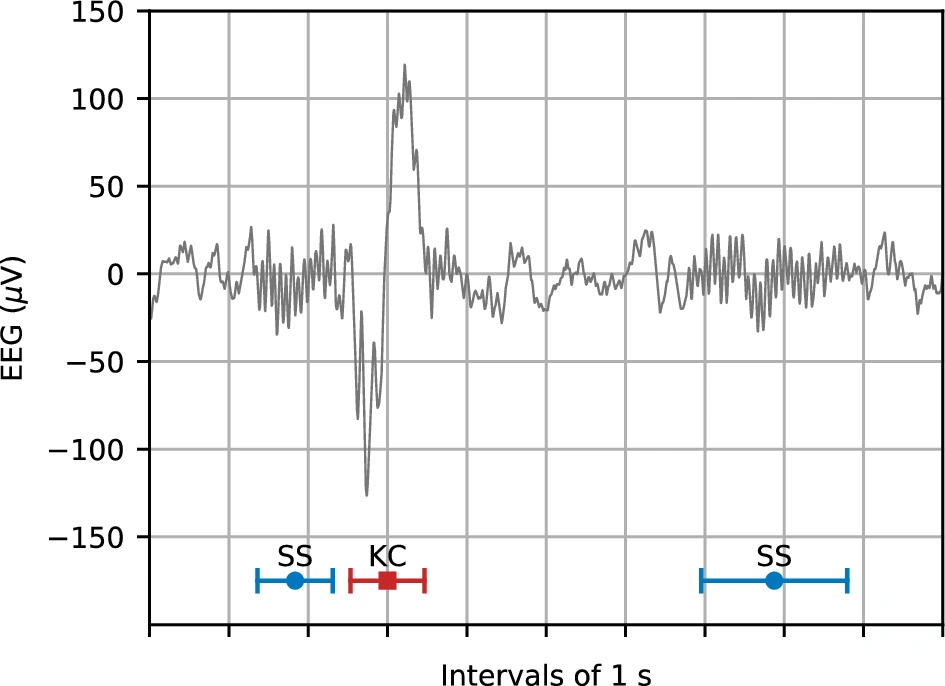
This N2 sleep recording shows one K-complex (KC) and two sleep spindles (SS), two characteristic patterns of brain activity during this stage.
Stage 3: N3 Sleep (Deep Sleep, 15%–25%)
N3 is also known as slow-wave sleep. Its main characteristic is low-frequency, high-amplitude slow-wave activity in the brain. During this stage, heart rate and breathing rate are low, muscles are fully relaxed, and the body becomes less sensitive to external stimuli and harder to awaken. [6]
Deep sleep is concentrated primarily in the first half of the night and is closely associated with growth hormone secretion, tissue repair, immune function regulation, and memory consolidation. It is important for physical recovery and brain health. [6]
Stage 4: REM Sleep (Rapid Eye Movement Sleep, 20%–25%)
The first period of REM sleep typically occurs about 90 minutes after falling asleep. During this stage, brain activity increases significantly, the eyes move rapidly, skeletal muscle tone decreases substantially, and vivid dreams are more common. [6]
REM sleep is primarily involved in emotional regulation, memory integration, and learning. As the night progresses, REM sleep periods within each sleep cycle gradually lengthen and are concentrated primarily in the second half of the night. [2] [6] Therefore, insufficient sleep or waking up too early may reduce REM sleep.
How to Increase Core Sleep?
Core sleep accounts for the largest share of the overall sleep cycle, but more is not necessarily better. Because core sleep includes N1 and N2, frequent awakenings during the night followed by repeatedly falling back asleep may actually increase the proportion of N1. [4] Therefore, the key to improving core sleep is getting enough sleep, reducing sleep interruptions, and maintaining normal sleep cycles, rather than simply pursuing a particular percentage of any one sleep stage.
Get Enough Sleep
For most adults, getting 7–9 hours of sleep each night helps the body complete multiple full sleep cycles. [8] [2] Rather than simply increasing the percentage of core sleep, extending an insufficient total sleep duration is usually a more reasonable way to increase the absolute amount of time spent in core sleep.
Reduce Nighttime Noise and Sleep Interruptions
N1 and N2 are more susceptible to external stimuli than deep sleep. Traffic noise, a partner's snoring, and other sudden sounds can all cause awakenings and affect sleep continuity. [4] [6] If it is difficult to keep your sleeping environment quiet, passive sound isolation, active noise cancellation, or low-volume sound masking can reduce noise disturbances and create better conditions for stable sleep.
DUVA ONE sleep earbuds combine passive sound isolation, active noise cancellation (ANC), and personalized sleep audio, and can dynamically adjust sound strategies based on changes in sleep state and environmental noise. This helps reduce sleep interruptions caused by external noise and creates a quieter, more stable sleeping environment for normal transitions between different sleep stages. Learn more about DUVA ONE
Maintain a Regular Sleep Schedule
Human sleep is jointly regulated by circadian rhythms and sleep pressure. Maintaining relatively consistent bedtimes and wake-up times, along with getting enough natural light during the day, helps stabilize sleep rhythms so the body can enter sleep at the appropriate time. [6] [5]
Reduce Physiological Arousal Before Bed
Caffeine, alcohol, psychological stress, and an unsuitable sleeping environment can all affect falling asleep and sleep continuity. [5] [6] Before bed, you can reduce tension through slow breathing, progressive muscle relaxation, or NSDR, while keeping the bedroom cool, quiet, and dark. The purpose of these methods is not to directly control a particular sleep stage, but to reduce factors that interfere with normal sleep cycles.
DUVA ONE reduces sleep disturbances through active noise cancellation, passive sound isolation, and personalized sleep audio. It also combines in-ear physiological monitoring with the smart charging case's temperature, humidity, light, and noise monitoring features to help users understand the factors affecting sleep quality and optimize their sleeping environment and sleep habits. Learn more about DUVA ONE
Frequently Asked Questions
Core Sleep vs. Deep Sleep: Which Is More Important?
Core sleep and deep sleep are equally important, but they serve different physiological functions.
- Core sleep is primarily involved in memory consolidation, information processing, and maintaining sleep stability
- Deep sleep focuses more on physical repair, growth hormone secretion, and immune regulation.
It is normal for core sleep to occupy most of the night's sleep. There is no need to deliberately reduce core sleep to increase deep sleep.
How Much Deep Sleep Do You Need Per Night?
Deep sleep typically accounts for 15%–25% of an adult's total sleep time. With 8 hours of sleep per night, this corresponds to approximately 72–120 minutes of deep sleep. Time spent in deep sleep gradually decreases with age. [2] Rather than pursuing a fixed duration of deep sleep, it is better to assess your sleep quality using long-term sleep data, the number of nighttime awakenings, and how alert and energized you feel the next day.
How Much REM Sleep Do You Need?
REM sleep typically accounts for 20%–25% of an adult's total sleep time. With 8 hours of sleep per night, this corresponds to approximately 96–120 minutes of REM sleep. Because REM sleep is more concentrated in the second half of the night, one of the most important ways to get enough REM sleep is to ensure sufficient total sleep time and avoid chronically cutting sleep short or ending sleep too early. [2] [6]
Final Thoughts
Core sleep is not lower-quality sleep. Rather, it is the largest component of the body's normal sleep cycle. From the transition into sleep and maintenance of the sleep state to memory consolidation, physical recovery, and emotional regulation, different sleep stages serve distinct but interconnected physiological functions.
Sleep tracking devices can help us understand the distribution of these stages, but no single sleep metric fully reflects sleep quality. Rather than pursuing more core sleep or deep sleep, it is more worthwhile to focus on whether you are getting enough sleep, whether your nighttime sleep is continuous, and whether you feel energized after waking up. [5] Maintaining a regular sleep schedule, reducing environmental disturbances, and improving sleep habits create better conditions for normal sleep cycles.
References
- Apple. Estimating Sleep Stages from Apple Watch. Updated October 2025.
- National Heart, Lung, and Blood Institute. How Sleep Works: Sleep Phases and Stages. 2022.
- NCBI — Physiology, Sleep Stages
- Shrivastava D, Jung S, Saadat M, Sirohi R, Crewson K. How to interpret the results of a sleep study. Journal of Community Hospital Internal Medicine Perspectives. 2014;4(5):24983. doi:10.3402/jchimp.v4.24983.
- Centers for Disease Control and Prevention. About Sleep. 2024.
- National Heart, Lung, and Blood Institute. Your Guide to Healthy Sleep. NIH Publication No. 11-5271. Revised August 2011.
- Tapia-Rivas NI, Estévez PA, Cortes-Briones JA. A robust deep learning detector for sleep spindles and K-complexes: towards population norms. Scientific Reports. 2024;14:263. doi:10.1038/s41598-023-50736-7. Figure 1 © The Author(s) 2024. CC BY 4.0.
- National Heart, Lung, and Blood Institute. How Sleep Works: How Much Sleep Is Enough? 2022.