How Do Smartwatches Track Sleep Stages? A Guide to Understanding Your Sleep Data
Every morning, smartwatches can tell us how long we slept, how much deep sleep and REM sleep we got, and even give us a sleep score. But these devices do not directly monitor the brain, so how do they identify sleep stages? This article explores the sensor technology and scientific principles behind smartwatches, explains the roles of different sleep stages, and offers a practical guide to reading your sleep report—helping you decide which metrics deserve your attention and how to interpret the data your device provides.
In a professional sleep lab, researchers typically use polysomnography (PSG) to assess sleep. During the test, technicians place electrodes on the scalp, around the eyes, and on the chin to record brain activity (EEG), eye movements (EOG), and muscle activity (EMG), respectively. These signals are then used to identify different sleep stages. [1]
These signals matter because sleep stages are fundamentally defined by changes in brain activity, eye movements, and muscle tone. During deep sleep, for example, the brain produces pronounced, high-amplitude slow waves. REM sleep, meanwhile, is characterized by relatively active brain activity, rapid eye movements, and a marked reduction in skeletal muscle tone. [2]
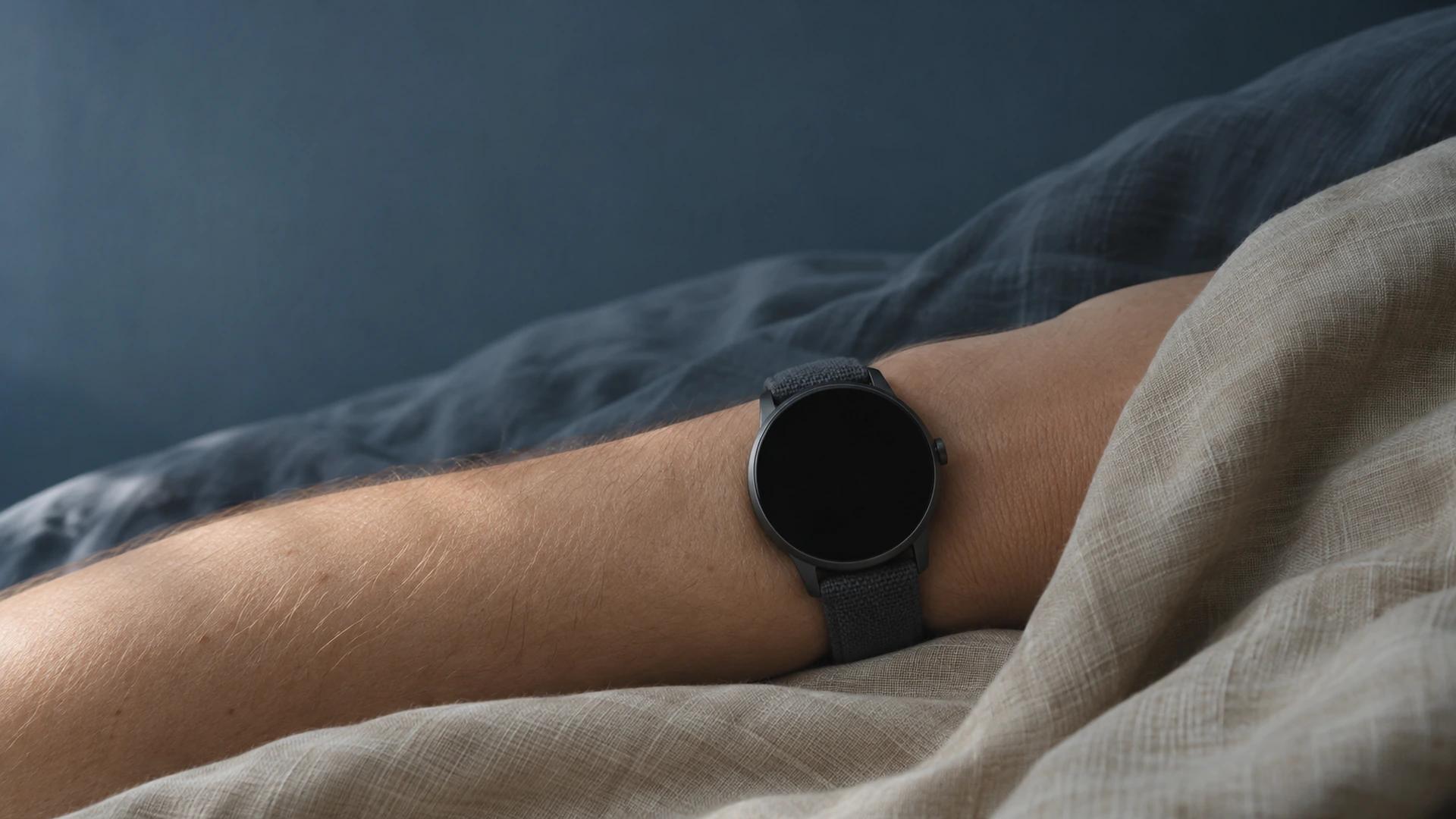
Smartwatches, however, do not have these electrodes and cannot directly read brain activity. Instead, they rely primarily on motion sensors, optical heart rate sensors, and other physiological signals, combined with algorithms, to estimate whether you are asleep and which sleep stage you may be in.
Smartwatch sleep staging is therefore an algorithmic estimate based on indirect physiological signals, not a direct measurement of sleep stages using brain activity. [1]
How Do Smartwatches Track Sleep?
Most smartwatches with sleep-tracking features combine several sensors. Three-axis accelerometers and PPG optical sensors are the core technologies, while some devices also monitor blood oxygen and skin temperature to provide additional information.
3-Axis Accelerometer: Identifying Sleep Through Body Movement
A three-axis accelerometer measures changes in acceleration along the X, Y, and Z axes, allowing it to detect the intensity and frequency of wrist movements as well as changes in position.
As we prepare to fall asleep, physical activity usually decreases. As sleep deepens, limb movements often decrease further. Algorithms can use these patterns of activity over time to assess whether the wearer may have fallen asleep.
However, being still does not mean being asleep. Someone lying in bed quietly reading, meditating, or thinking while awake may also remain still for long periods. With motion sensors alone, a device can easily mistake these periods of quiet wakefulness for sleep. [1]
This is why modern sleep trackers generally do not rely on accelerometers alone, but also incorporate cardiovascular signals.
PPG Optical Sensors: Estimating Sleep State Through Heart Rate and HRV
Photoplethysmography (PPG) is an important technology in smartwatch sleep tracking.
The principle is fairly straightforward: an LED shines light into the skin, and a photodetector picks up the reflected light. Each heartbeat changes the blood volume in the surrounding tissue, causing subtle changes in how light is absorbed and reflected. [9]

Reflective PPG: the LED and photodetector are on the same side of the tissue.
Source: Park et al. (2022), Figure 2B [9].
By analyzing these periodic changes, the device can estimate pulse rate and the intervals between pulses, then calculate heart rate and metrics similar to heart rate variability (HRV). However, pulse interval variability derived from PPG is not exactly the same as HRV measured with an electrocardiogram. [3]
Why can these data help identify sleep stages?
Because different sleep stages are accompanied by changes in autonomic nervous system activity.
During more stable NREM sleep, heart rate typically decreases and cardiovascular activity becomes more regular. During REM sleep, heart rate and autonomic activity often become more variable, and breathing may also become less regular. [2]
Algorithms can recognize these patterns and combine them with body movement and changes across the night to estimate the likelihood of different sleep stages.
Blood Oxygen Sensors (SpO₂): Monitoring Oxygenation During Sleep
Some smartwatches also support blood oxygen saturation monitoring. This usually relies on optical technology as well, but works differently from standard heart rate measurement.
Oxygenated and deoxygenated hemoglobin absorb red and infrared light differently. By comparing light signals at different wavelengths, the sensor estimates peripheral oxygen saturation (SpO₂). [8]
The main purpose of blood oxygen monitoring is not to identify deep sleep or REM directly, but to provide information about nighttime breathing and oxygenation. Some sleep-related breathing disorders, for example, can cause repeated drops in blood oxygen.
Skin Temperature Sensors: Detecting Temperature Changes Around Sleep Onset
Body temperature regulation is closely linked to sleep. As we prepare to fall asleep, blood vessels in peripheral areas such as the hands and feet typically dilate, helping the body release heat. During this process, core body temperature tends to decrease, while skin temperature in some peripheral areas may actually rise. Changes in skin temperature can therefore offer additional clues about sleep onset and circadian rhythms. [4]
How Do Algorithms Turn These Signals into Sleep Stages?
Sleep staging is not performed by any single sensor. It depends on the data processing and machine learning algorithms behind it.
During algorithm development, researchers can use simultaneously recorded PSG and wearable device data to train models to recognize the combinations of movement, heart rate, HRV, and other physiological signals that typically correspond to different sleep stages.
When a user wears the device to sleep at home, the algorithm analyzes these signals and estimates whether each period most likely represents wakefulness, light sleep, deep sleep, or REM sleep.
This is how a smartwatch can generate an overnight sleep-stage chart. Still, the algorithm produces a probability-based estimate; it does not mean the device has directly observed brain activity.
How to Read Your Sleep Report
Once we understand how sleep tracking works, the more important question is: when a sleep report contains a dozen or more metrics, which ones should we look at first?
For adults without a known sleep disorder who mainly want to improve their everyday sleep quality, the following order is recommended:
Total sleep time and regularity → Sleep continuity → Heart rate and HRV trends → Breathing metrics → Sleep stages.
Blood oxygen should be considered separately. It is not a metric to optimize for a higher sleep score, but repeated abnormal readings may be more medically important than any of the everyday sleep improvement metrics above.
Total Sleep Time
Total sleep time is an important measure of sleep quality. Adults are generally advised to get 7–9 hours of sleep each night, giving the body enough time to complete different sleep cycles. Insufficient sleep may cut short the REM sleep that is more abundant in the second half of the night. [5] [2]
Sleep Continuity
Sleep continuity reflects how often sleep is interrupted throughout the night, with a focus on sleep efficiency, sleep onset latency, and time spent awake during the night. Sleep efficiency of ≥85%, taking less than 30 minutes to fall asleep [6], and spending less than 30 minutes awake after initially falling asleep can generally serve as reference points. Frequent awakenings may affect sleep quality, so even if you get 8 hours of sleep, it is worth paying attention to how uninterrupted that sleep is.
Heart Rate & HRV
Nighttime heart rate and HRV can offer insight into your physiological state and autonomic regulation. Heart rate typically decreases during sleep, but there is no universal healthy HRV value. It is affected by factors such as age, exercise, stress, and health. Rather than aiming for a fixed number, focus on your own long-term baseline. If your HRV remains below its usual level while your nighttime heart rate rises, it may suggest that your body has recently been under greater strain. [7]
Blood Oxygen
Nighttime blood oxygen monitoring is mainly used to observe oxygenation during sleep and identify drops that may be related to abnormal breathing. Healthy adults at low altitudes typically have oxygen saturation levels of 95%–100%. [8] If your device repeatedly records significant drops, particularly alongside snoring or waking up gasping, further evaluation is recommended.
Sleep Stages
Sleep is broadly divided into NREM (non-rapid eye movement) sleep and REM (rapid eye movement) sleep, with NREM further divided into N1, N2, and N3. N1 is the transition from wakefulness to sleep. N2 helps maintain stable sleep and contributes to memory consolidation. N3 is deep sleep, closely associated with physical recovery, hormone secretion, and immune regulation. REM is primarily associated with emotional processing, learning, and memory. Smartwatches typically combine N1 and N2 into light sleep, so their reports generally show only three sleep stages: light sleep, deep sleep, and REM. [2]
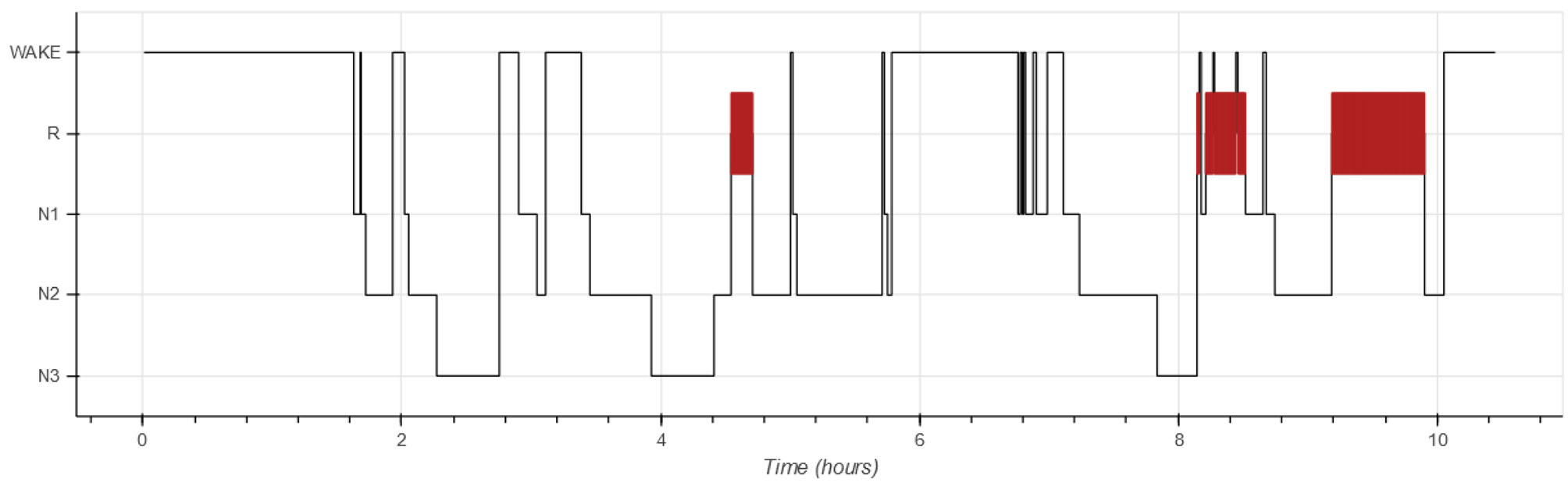
Example of an expert-scored hypnogram. R denotes REM sleep.
Source: Van der Plas et al. (2021), Figure 1 [10].
Beyond the Wrist: Why Pay Attention to Your Sleep Environment?
Sleep is not influenced solely by your internal physiological state. Nighttime noise, light, room temperature, and bedroom comfort can all affect your ability to fall asleep and stay asleep. This raises another question: if a device can only tell us when we woke up, but cannot provide information about changes in the bedroom environment, we may still struggle to understand the circumstances surrounding some sleep interruptions.
DUVA ONE combines in-ear physiological monitoring and bedroom environment sensing in a single sleep system.
Sensors built into the earbuds, including PPG sensors, track heart rate, HRV, and signals related to sleep staging, while motion sensors provide information about body movement. Meanwhile, the Smart Sensing Case can monitor changes in surrounding noise, light, temperature, and humidity.
This allows users to review not only their sleep status but also environmental records to look for possible contributing factors. For example, when nighttime awakenings increase, they can check whether there were noticeable changes in noise during the same periods. Environmental changes occurring alongside awakenings do not directly prove a causal relationship, but they can provide useful clues for further investigation.
DUVA ONE can also adjust audio support within the user’s settings in response to detected changes—for example, using adaptive sound masking to reduce disruptions from sudden noises. Learn more about DUVA
Frequently Asked Questions
Is it bad if my smartwatch shows very little deep sleep?
Not necessarily. Deep sleep duration is affected by age, total sleep time, sleep schedules, and individual differences, and consumer devices can make errors when estimating sleep stages. An occasional low deep sleep reading is not an immediate cause for concern. What matters more is whether you are consistently getting too little sleep, experiencing frequent interruptions, or feeling persistently tired the next day.
Why do different smartwatches show different sleep stages?
Devices differ in their sensors, wearing locations, signal processing methods, and machine learning models. Some algorithms may be more likely to classify a given period as light sleep, while others may label it REM or wakefulness. Even wearing two devices at the same time can produce different sleep reports. A better approach is to use the same device to follow your own changes over time rather than directly comparing numbers across brands. [1]
Can a smartwatch detect sleep apnea?
Some devices with the appropriate features and regulatory authorization can flag the risk of sleep apnea, but standard sleep-tracking features cannot replace a formal diagnosis. Nighttime oxygen fluctuations, abnormal breathing, or frequent awakenings may offer clues, but they are not enough to confirm sleep apnea. If you have persistent, severe snoring, wake up gasping, or experience pronounced daytime sleepiness, seek a professional sleep evaluation.
How much deep sleep and REM sleep do I actually need?
For young adults, deep sleep commonly accounts for about 13%–23% of sleep in laboratory studies, while REM accounts for about 20%–25%. However, these proportions vary with age and individual circumstances, and they are not targets that consumer devices must show. Rather than chasing precise percentages, it is more important to get enough total sleep, keep a regular schedule, and maintain good daytime energy after waking.
Final Thoughts: Don’t Let Your Sleep Score Decide How You Feel Today
Smartwatches have made it more convenient than ever to observe our sleep. But we also need to understand that these devices provide estimates based on sensor signals, not direct measurements from a sleep lab.
First, avoid directly comparing sleep-stage data across brands. Devices may differ in sensor placement, signal processing, and sleep-staging algorithms. Even for the same night of sleep, Apple Watch, WHOOP, and Oura may produce different results.
Second, do not rely too heavily on your sleep score. It is typically a composite result calculated by the manufacturer by weighting multiple metrics, and there is no universal scoring standard across brands. Even a seemingly high score cannot replace your own assessment of how you slept and how alert you feel during the day.
Finally, look at long-term trends rather than repeatedly analyzing individual nights. Several weeks of sleep duration, schedule consistency, nighttime awakenings, and heart rate changes are generally more worth your attention than 20 fewer minutes of deep sleep on a single night.
The goal of sleep tracking is not to make every metric perfect, but to help us identify what truly affects our sleep and make meaningful improvements.
References
- [1] Chinoy et al. (2021). Performance of seven consumer sleep-tracking devices compared with polysomnography.
- [2] National Heart, Lung, and Blood Institute. Sleep Stages.
- [3] Schäfer and Vagedes (2013). How accurate is pulse rate variability as an estimate of heart rate variability? A review on studies comparing photoplethysmographic technology with an electrocardiogram.
- [4] Harding, Franks, and Wisden (2020). Sleep and thermoregulation.
- [5] Hirshkowitz et al. (2015). National Sleep Foundation’s sleep time duration recommendations: methodology and results summary.
- [6] Ohayon et al. (2017). National Sleep Foundation’s sleep quality recommendations: first report.
- [7] Shaffer and Ginsberg (2017). An Overview of Heart Rate Variability Metrics and Norms.
- [8] MedlinePlus. Pulse Oximetry.
- [9] Park, J., Seok, H. S., Kim, S.-S., and Shin, H. (2022). Photoplethysmogram Analysis and Applications: An Integrative Review. Frontiers in Physiology. Adapted from Figure 2B under CC BY 4.0.
- [10] Van der Plas, D., Verbraecken, J., Willemen, M., Meert, W., and Davis, J. (2021). Evaluation of Automated Hypnogram Analysis on Multi-Scored Polysomnographies. Frontiers in Digital Health. Figure 1 reproduced under CC BY 4.0.