


Sleeping Poorly or Waking Up During the Night? How to Check Your Bedroom's Sleep Environment
1. Why Do You Keep Waking Up During the Night? What Can Change in Your Bedroom Overnight?
Your room feels perfectly comfortable at bedtime, but in the middle of the night, you get so hot that you throw off the covers. You wake up before your alarm and realize sunlight is already coming through a gap in the curtains. Sometimes you wake up suddenly, only to find everything quiet, with no idea what just happened. Your bedroom at bedtime only tells you what the environment is like at that moment. The air conditioner cycles on and off, the room temperature changes, and sounds or light from outside may appear during the night. By the time you wake up, some of those disturbances may already be over. [6]
Keeping your bedroom cool, quiet, and dark is common advice for creating a good sleep environment. [1] But to put that advice into practice in your own room, the first step is figuring out which factors are worth adjusting.
2. Could Waking Up Hot, Waking Too Early, or Having a Dry Mouth in the Morning Be Related to Your Sleep Environment?
You may not clearly recognize that you woke up because you were hot or because a sound disturbed you. [6] Start by looking for clues in how your body feels, when you wake up, and how you sleep in different rooms.

You're comfortable at bedtime but keep throwing off the covers during the night.
Check whether the air conditioner is set to turn off, whether your comforter is too heavy, and whether the room gets warmer later in the night. If the room temperature doesn't change much, your bedding may be making it increasingly warm and stuffy under the covers. [2]You keep waking up at roughly the same time early in the morning.
Check whether morning sunlight reaches your pillow or whether traffic, garbage collection, or family members getting up start making noise nearby. [6][7] Regular early awakenings make these factors worth checking, but the timing alone doesn't establish the cause.Your mouth and nose feel dry in the morning, or your bedding feels damp and clammy.
You can check the humidity and how the air conditioner is running. However, dry mouth can also be related to factors such as mouth breathing, so it shouldn't automatically be blamed on dry air. [3]You sleep noticeably differently in another room.
Compare the bed placement, the direction the windows face, bedding, air conditioning, and noise sources in the two rooms. These differences can help narrow down what to check, but changes in activity levels and routines while traveling also need to be considered.
These observations are useful because they suggest where to start looking. They're clues, not conclusions.
3. Where Should You Start Checking Your Sleep Environment When You're Not Sleeping Well?
You don't need to get up in the middle of the night to check your environment. You can divide your observations into a bedtime check, a morning record, and overnight monitoring if needed.
How Can You Check Your Bedroom's Air Conditioning, Light, and Noise Before Bed?
Take a few minutes to check:
Will the air conditioner shut off on a timer? Does sleep mode change the temperature or fan speed?
Will a fan, humidifier, or air purifier change settings on a timer?
Once the lights are off and you're lying down, can you see light coming through gaps in the curtains, light from the hallway, or indicator lights on devices? [7]
With your head on the pillow, is it easier to hear a particular device vibrating or humming?
Try to check from the position you actually sleep in. What you notice while standing in the middle of the room may be different from what you notice in bed.
How Do You Keep a Sleep Record? What Should You Include in a Sleep Diary?
After getting up, take a minute to jot down a rough account of the night:
I woke up about twice last night and felt hot one of those times. It was bright by the window in the morning. The air conditioner was set to shut off on a timer, and I was using a heavy comforter.
You don't need to remember the exact time of every awakening or aim for a perfectly complete record. If you happen to wake up during the night, notice what stands out most at that moment and write it down the next morning, rather than repeatedly checking your phone to keep a record. [7][8]
A sleep diary can also track caffeine, alcohol, medications, and daytime sleepiness, helping you avoid attributing every change to your bedroom. The National Heart, Lung, and Blood Institute provides a sleep diary you can use as a reference. [4]
How Should You Read Overnight Temperature, Humidity, Light, and Noise Data From Your Bedroom?
If your device supports overnight recording, focus on:
Temperature and humidity: Do they change gradually later in the night? Do those changes happen around the time a device turns on or off?
Noise: Are there brief spikes? At what times do they tend to occur? [6]
Light: Does it start increasing before you plan to get up?
For example, two nights may have the same average temperature, but on one night it stays relatively steady, while on the other it rises noticeably in the early morning hours. Looking only at the average makes it easy to miss that difference.
It's also important to understand how often your device takes readings. Some devices can't capture every brief sound, so a graph with no obvious changes doesn't completely rule out noise as a source of disruption. Position the device according to its instructions and try to keep its location consistent to make comparisons more meaningful.
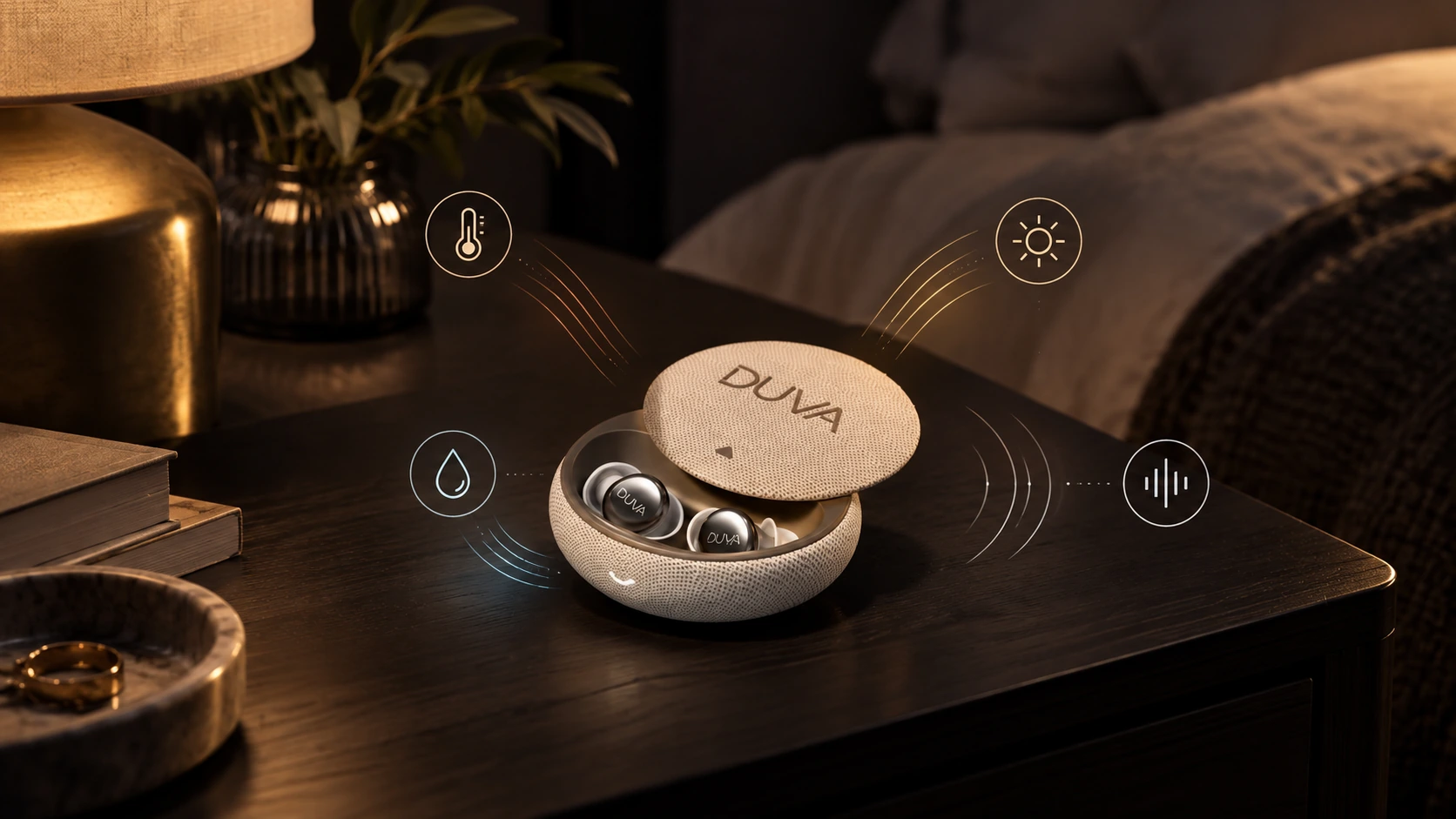
DUVA ONE is more than a pair of sleep earbuds—it can also help you better understand your bedroom's sleep environment. Environmental sensors built into the charging case detect changes in your bedroom's temperature, humidity, light, and noise, helping you identify environmental factors that may affect your sleep. Combined with the earbuds' sleep-tracking features, DUVA ONE can provide a more complete picture of your sleep environment to help you gradually improve your sleeping conditions.
4. How Can You Use Sleep Records to Assess Whether Your Environment Is Related to Poor Sleep?
Start by keeping a record for a few nights in a row and treat it as a simple way to investigate. This isn't a diagnostic test, and there is no fixed number of days you have to complete.
Record just four things each night: that night's settings, how you slept, environmental clues, and any other noticeable changes.
For example:
The air conditioner shut off at two in the morning. I woke up feeling hot later in the night. The monitoring data showed the temperature gradually rising after it shut off. I hadn't had coffee any later than usual that day.
Then ask yourself three questions.
First, does the same situation keep happening?
Waking up hot once doesn't tell you much. If it happens several times after the air conditioner turns off, that setting is worth checking first.
Second, what's different on the nights when you sleep better?
Don't just look for what happens when you sleep poorly. Also look at how the environment or settings differ on nights when you don't notice any particular discomfort.
Third, could there be another explanation?
Working late, stress, alcohol, late-day coffee, or feeling unwell can all affect how you sleep that night. [5] A brief note is enough; keeping a record doesn't need to become a burden. [8]
An environmental change happening close to the time you wake up only suggests something worth investigating further—it doesn't establish cause and effect. The next step is to change one factor and see whether your experience improves. Once you've identified a possible factor, how can you adjust it in a way that helps you tell whether it makes a difference? Start with the most obvious factor that's easiest to change.
Sleep Environment FAQs
Does Waking Up With a Dry Mouth Mean Your Bedroom Air Is Too Dry?
Not necessarily. You can check your bedroom's humidity and how the air conditioner is running, but factors such as mouth breathing at night can also cause dry mouth. Dry mouth isn't a substitute for measuring humidity, and it doesn't establish that your bedroom air is the cause. [3]
Do You Need to Buy a Monitoring Device to Check Your Sleep Environment?
Not necessarily. Start by lying in your usual sleeping position and checking the air conditioner settings, bedding, light coming into the room, and noise. Then record how you slept in the morning. If you still can't find any clues, consider using a device that records throughout the night rather than looking only at a single reading before bed.
How Many Days in a Row Should You Keep a Sleep Diary?
If you're simply checking your bedroom environment, start with a few nights in a row. Look for situations that keep happening and compare them with nights when you sleep better. There is no fixed number of days required for this simple investigation, and recording a few nights isn't a substitute for a diagnosis.
If You Wake Up During the Night, Do You Need to Record the Time on Your Phone Right Away?
Why Should You Adjust Only One Factor at a Time When Improving Your Sleep Environment?
Changing just the most obvious factor that's easiest to adjust makes it simpler to compare your experience before and after. For example, adjust the air conditioner's timer first, observe for a few nights, and then consider your bedding or window coverings. Also note changes in stress, caffeine, and alcohol, since these can affect sleep too. Even if you sleep better, a few nights of records alone can't establish cause and effect. [5]
What Evidence and References Support This Article's Sleep Environment Advice?
[1] National Health Service (NHS). How to fall asleep faster and sleep better. Every Mind Matters; the page does not list an update year.
[2] Okamoto-Mizuno K, Mizuno K. Effects of thermal environment on sleep and circadian rhythm. Journal of Physiological Anthropology. 2012;31:14. DOI: 10.1186/1880-6805-31-14.
[3] National Health Service (NHS). Dry mouth. NHS; last reviewed: 2023-11-29.
[4] National Heart, Lung, and Blood Institute (NHLBI). Sleep Diary. 2019-01. Accessible version: Medical Learning Institute (MLI), Patient Sleep Diary (PDF).
[5] National Health Service (NHS). Insomnia. NHS; last reviewed: 2024-03-19.
[6] Basner M, McGuire S. WHO Environmental Noise Guidelines for the European Region: A Systematic Review on Environmental Noise and Effects on Sleep. International Journal of Environmental Research and Public Health. 2018;15(3):519. DOI: 10.3390/ijerph15030519.
[7] Cambridge University Hospitals NHS Foundation Trust. Achieving better sleep: a patient’s guide. 2024 (approved 2024-07-19, version 3). CUH.
[8] Oxford Health NHS Foundation Trust. Keeping a sleep diary. 2024 (last reviewed 2024-02-07). Oxford Health CAMHS.