


NSDR for Sleep: What Is NSDR and How Does It Work?

Sometimes, even when you are exhausted, you still cannot relax once you lie down in bed. Your body wants to rest, but your mind is still going over the day's events or thinking ahead to tomorrow's plans. At times like these, rather than trying hard to fall asleep, you might first try letting your body and mind gradually settle down.
NSDR (Non-Sleep Deep Rest) is a category of practices that promote relaxation through guided breathing, body scans, and shifts in attention.1 It does not require you to fall asleep. Instead, it helps you temporarily set aside outside distractions while you remain awake or gradually drift toward sleep.
NSDR shares some similarities with meditation, but their focus is not exactly the same. So what exactly is NSDR? Can it really help improve sleep? And if you want to add it to your bedtime routine, how should you begin?
What Is NSDR?
NSDR stands for Non-Sleep Deep Rest, commonly translated into Chinese as “deep rest without sleep.”
The term was popularized by neuroscientist Andrew Huberman to describe a category of practices that can promote deep relaxation without fully falling asleep, including Yoga Nidra and certain forms of meditation.1 Common NSDR practices are typically audio-guided. You can sit or lie down and follow prompts to focus on your breathing, sensations in different parts of your body, or simple visualization exercises. The process does not involve complicated movements or require special meditation skills.
How Do NSDR, Yoga Nidra, and Meditation Differ?
All three may involve breathing and body awareness, but they differ in their origins, focus, and specific methods.
Comparison Category | NSDR (Non-Sleep Deep Rest) | Yoga Nidra | Meditation |
|---|---|---|---|
Concept | An umbrella term for a category of deep-rest practices | A relaxation method with a specific system of practice | A broad concept encompassing various forms of attention and awareness training |
Origins | A modern term popularized by neuroscientist Andrew Huberman | Rooted in the yoga tradition and later developed into structured modern practices | Has a long history, with various traditional and modern forms |
Primary Focus | Allowing the body and mind to rest without having to actually fall asleep | Entering a state of deep relaxation through structured guidance | Developing attention, awareness, and the ability to observe thoughts and emotions |
Methods | Guided breathing, body scans, and other methods, with no single fixed sequence | Usually involves body scans, breath awareness, and visualization exercises in a specific order | Focusing on breathing, observing thoughts, and refocusing when the mind wanders, among other methods |
Distinctive Features | Emphasizes rest as the goal and can draw on various existing relaxation methods | Some schools include specific elements such as setting a personal intention (Sankalpa) | Relaxation is not necessarily the goal; the focus may also be on concentration and mindfulness training |
How the Three Relate | Can encompass Yoga Nidra and certain forms of meditation | One specific method that can be used for NSDR | Some meditation methods can also be used for NSDR |
Simply put: meditation focuses more on training awareness; Yoga Nidra is a relatively specific set of deep-relaxation practices; and NSDR is a broader concept that emphasizes rest as the goal.16
It is worth noting that there is no strict technical dividing line between NSDR and Yoga Nidra. The same guided Yoga Nidra recording may also be called NSDR. The distinction is mainly in the scope of the concepts and the structure of the practices, rather than in their being two completely different relaxation techniques.
How Do You Practice NSDR?
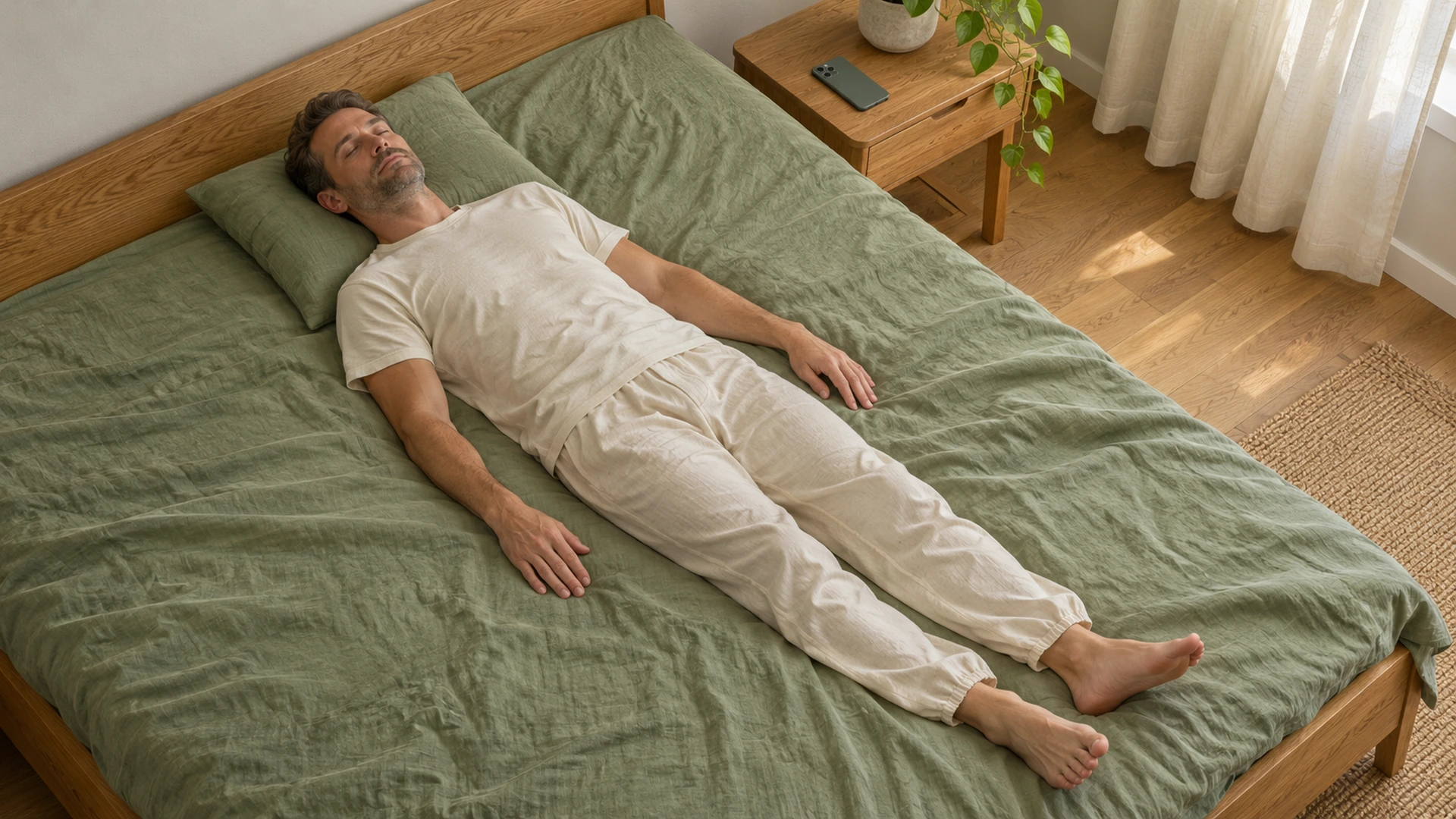
A typical practice involves sitting or lying comfortably in a quiet place, closing your eyes, and following the audio's breathing or body-awareness prompts.12 The guided recording will tell you what to do. You can try the following sequence:
- Choose a guided recording before bed. Huberman Lab’s NSDR page lists guided recordings.1 Preview the beginning and end: Are you comfortable with the voice? Are the instructions easy to understand? Does the ending ask you to return to wakefulness? Before settling in, check for ads and whether other content will play automatically afterward.
- Find a comfortable position. Sit with support or lie down in a quiet place. Before starting, adjust anything that feels tight or puts pressure on you; if you become uncomfortable later, change positions.
- Start playback and set the screen aside. Adjust the volume so you can comfortably hear the guidance clearly.
- Follow one prompt at a time. If you are asked to notice your feet, feel their contact with the surface beneath them. When the guidance moves to another area, shift your attention there as well. Follow breathing prompts only if they feel comfortable; do not force your breathing or strain to keep pace with the narrator.
- Continue with the next prompt. If you notice that you have been thinking about tomorrow, pick up wherever the recording is now.
In a shared bedroom, using a personal audio device is usually more convenient than playing audio through a speaker: you can hear the NSDR guidance clearly and are less likely to disturb your partner. If you are accustomed to wearing in-ear earbuds, DUVA ONE is an option to consider. Its low-profile design fits close to the ear and is intended to reduce pressure between the earbuds and your pillow when you sleep on your side.3
In addition to audio playback, DUVA ONE includes in-ear physiological monitoring that can track heart rate, heart rate variability (HRV), and sleep-related data, helping users observe their sleep over time. Its smart charging case can also monitor bedroom temperature, humidity, light, and noise, providing additional information about the sleep environment.3 These data can help users observe changes in their sleep and environment. Explore DUVA ONE.
Who Might Consider Trying NSDR Before Bed?
NSDR does not require prior specialized training or ask you to achieve a particular state of relaxation. The following groups may find it easier to discover an approach that suits them through this guided practice.
- People who are not used to traditional meditation: If your mind wanders easily when you focus on your breathing on your own, or you do not know how to begin, NSDR's audio guidance provides clear steps to follow through the practice, without requiring you to learn meditation skills beforehand.
- People who find it hard to stick with progressive muscle relaxation: Traditional progressive muscle relaxation typically involves tensing and relaxing different muscle groups in sequence,4 while body-scan-focused NSDR can involve simply noticing sensations in different parts of the body, without deliberately contracting muscles. For people who dislike repeatedly tensing their muscles, this may be a more approachable alternative.
- People who do not enjoy a completely silent setting for relaxation: Some people find that a quiet environment makes them pay constant attention to their thoughts instead. Guided NSDR provides ongoing spoken prompts, giving attention something specific to follow rather than relying entirely on your own ability to stay focused.
- People who do not want relaxation practice to become another task: Some people worry that they are not focused enough during meditation or that they do not notice a clear effect afterward. NSDR can serve as a set period of rest, without needing to track completion or judge the practice by whether you fall asleep.
These features do not mean that NSDR is necessarily more effective than meditation or other relaxation methods. Its advantages lie more in its flexibility and relatively beginner-friendly guided format.
However, relaxation practices are not suitable for everyone. The National Center for Complementary and Integrative Health (NCCIH) notes that some people may have negative experiences during practice, such as increased anxiety or intrusive thoughts.4 If the practice clearly worsens your discomfort, stop and seek professional advice if needed.
When Should You Practice NSDR, and How Long Should Each Session Be?
Should You Practice When You Are Already Sleepy or Before Getting Ready for Sleep?
If your goal is to relax before bed, you can make NSDR part of your wind-down routine.
NSDR can serve as a transition between daily activities and going to sleep. For example, after finishing your bedtime hygiene routine, listen to a 10–20-minute guided recording to gradually shift your attention from work, your phone, or other activities to your breathing and bodily sensations. When you genuinely feel sleepy, get ready to sleep.
If you are already noticeably sleepy, there is no need to delay sleep to finish NSDR. It is an optional relaxation method, not a step you must complete every night before going to sleep.
You can also schedule NSDR flexibly to meet different needs for rest:
- Daytime rest: NSDR is not limited to nighttime. During a lunch break or a break from work, a brief practice can also provide some quiet time to rest. Unlike a nap, it does not require you to actually fall asleep.

- Chronic insomnia or ongoing CBT-I: If you are not yet sleepy, you can practice outside of bed first to avoid lying awake in bed for a long time just to finish the recording. If you are receiving cognitive behavioral therapy for insomnia, prioritize your existing stimulus-control plan.5
How Long Does an NSDR Session Take?
Common guided NSDR recordings come in versions such as 10, 20, and 30 minutes.1 Beginners can start with 10 minutes to become familiar with the basic process of guided breathing and body scans. If you prefer a more complete relaxation session, you can also choose a 20–30-minute recording. Choose a length that fits your schedule and habits; you do not need to delay your normal bedtime to finish the practice.
What Might You Feel During Practice?
During NSDR, some people may feel their breathing gradually steady, their muscles relax, and their body become heavy or warm. Others may feel sleepy or even fall asleep before the guidance ends. You may also find your mind wandering occasionally, or remain awake after listening to the entire recording. These are all possible experiences, and they do not mean the practice has succeeded or failed. NSDR does not require you to enter a particular state or deliberately pursue a feeling of relaxation. If you feel anxious or uncomfortable during the process, you can adjust the practice or stop.
Frequently Asked Questions (FAQs)
Is It Okay to Fall Asleep During NSDR?
Can You Fall Asleep During NSDR?
Yes. If you practice NSDR before bed, it is fine to fall asleep naturally during the practice. NSDR does not require you to stay awake, and you do not need to force yourself to remain awake to hear the entire recording. If you practice during the day and want to return to work afterward, you can choose a shorter recording or set a reminder.
Why Can't I Relax During NSDR?
Why Can't I Relax During NSDR?
Some people keep checking whether they have relaxed or try hard to follow every spoken prompt, which can make them more tense instead. A pace that is too fast, unnatural breathing, or an uncomfortable position can also affect the experience. You can try a simpler body-scan recording without deliberately pursuing a particular state of relaxation.
What If My Mind Keeps Wandering During NSDR?
What If My Mind Keeps Wandering During NSDR?
Mind wandering is very common. You might suddenly think about work while focusing on your breathing, or miss a few prompts. When you notice your mind has wandered, simply continue following wherever the recording is now. You do not need to replay it or start over. NSDR does not require intense focus throughout the session.
Does Listening to Rain Sounds or Relaxing Music Count as NSDR?
Is Listening to Rain Sounds or Relaxing Music the Same as NSDR?
Not exactly. Simply listening to rain sounds or relaxing music mainly creates a comfortable environment through sound, while common guided NSDR practices typically include specific steps such as breath awareness and body scans. Both can be used to relax before bed, but the methods differ. If you do not like spoken guidance, you can also choose background sounds that suit you.
Can NSDR Replace a Nap?
Can NSDR Replace a Nap?
NSDR can be an option for a brief daytime rest, especially for people who cannot take a nap or find it difficult to fall asleep during the day. It does not require actually falling asleep, so it can fit into a limited rest period. If your body is genuinely short on sleep, NSDR cannot directly replace a nap or normal nighttime sleep.2
Can NSDR Really Help Improve Sleep?
Can NSDR Really Improve Sleep?
By helping the body and mind relax, NSDR may make it easier for some people to prepare for sleep. Some studies of Yoga Nidra have found potential sleep benefits,7 but high-quality research directly examining NSDR remains limited,2 and it is not yet clear whether it can significantly shorten the time it takes to fall asleep, reduce nighttime awakenings, or improve overall sleep quality. NSDR is therefore better suited as a supplementary way to relax before bed rather than a treatment for insomnia. For people with chronic insomnia, cognitive behavioral therapy for insomnia (CBT-I) generally remains the recommended first-line treatment.5
References
- Huberman Lab. “Non-Sleep Deep Rest (NSDR).” No date provided. https://www.hubermanlab.com/nsdr
- Summer, Jay Vera. “Non-Sleep Deep Rest (NSDR).” Sleep Foundation. Updated October 13, 2026. https://www.sleepfoundation.org/meditation-for-sleep/what-is-non-sleep-deep-rest
- DUVA. “DUVA ONE | Closed-Loop Sleep System & Sleep Earbuds.” No date provided. https://duva.com/products/duva-one
- National Center for Complementary and Integrative Health. “Relaxation Techniques: What You Need To Know.” Updated June 2021. https://www.nccih.nih.gov/health/relaxation-techniques-what-you-need-to-know
- National Heart, Lung, and Blood Institute. “Insomnia: Treatment.” Updated March 24, 2022. https://www.nhlbi.nih.gov/health/insomnia/treatment
- National Center for Complementary and Integrative Health. “Meditation and Mindfulness: Effectiveness and Safety.” Updated June 2022. https://www.nccih.nih.gov/health/meditation-and-mindfulness-effectiveness-and-safety
- Datta K, Tripathi M, Verma M, Masiwal D, Mallick HN. “Yoga nidra practice shows improvement in sleep in patients with chronic insomnia: A randomized controlled trial.” 2021. The National Medical Journal of India, 34(3):143–150. DOI: 10.25259/NMJI_63_19. https://nmji.in/yoga-nidra-practice-shows-improvement-in-sleep-in-patients-with-chronic-insomnia-a-randomized-controlled-trial/