


Do Sleep Earbuds Really Block Out Noise? ANC vs. PNC vs. Sound Masking
Both are noise, so why do an air conditioner's hum and a partner's snoring call for different noise-reduction methods? Because different types of noise have different sound characteristics. An air conditioner usually produces a continuous, steady, low-frequency hum, while snoring constantly changes in volume, frequency, and rhythm. Sometimes it even gets suddenly louder, waking you from sleep. WHO lists sleep disturbance as one of the health effects of environmental noise. [1]
That means the same method cannot effectively reduce every kind of noise. To reduce nighttime noise disturbances, you first need to understand the differences between passive noise isolation, active noise cancellation (ANC), and sound masking.
How Do Sleep Earbuds Reduce Noise?
Sleep earbuds primarily reduce noise disturbances in three ways: passive noise isolation, active noise cancellation (ANC), and sound masking. They work differently and are suited to different types of noise.
1. How Does Passive Noise Isolation Work in Sleep Earbuds?
Passive noise isolation relies on a physical seal between the ear tips and your ear canals to block some outside sound, without turning on any electronic features. For example, when you put on a pair of sleep earbuds with a good seal, nearby voices, keyboard sounds, and some high-frequency noise may seem quieter even without ANC turned on.
Passive noise isolation mainly relies on three factors:
- Sealing: The ear tips fit snugly in your ear canals, reducing sound that enters through gaps.
- Blocking: The ear tips and earbud housings block some sound transmission.
- Absorption: Certain soft, porous materials can absorb some sound energy, reducing the sound that reaches your ear canals.
Ear tip size and fit are key. In general, a good seal can keep more outside sound from entering your ear canals. Choose ear tips and wings that feel comfortable, stay secure, and maintain a seal, rather than simply looking for a larger or smaller size. You can try different sizes for your left and right ears. NIDCD's hearing protection guidance also emphasizes the importance of proper use and a comfortable fit.
2. How Does Active Noise Cancellation (ANC) Reduce Background Noise?
Sound is a wave. As sound travels through the air, it creates changing air pressure—sound waves. Sound waves have peaks and troughs.
When two sound waves arrive at the same place at the same time, they combine. If the peak of one wave meets the trough of the other, and their amplitudes are equal, they may cancel each other out. This phenomenon is called destructive interference . [2]
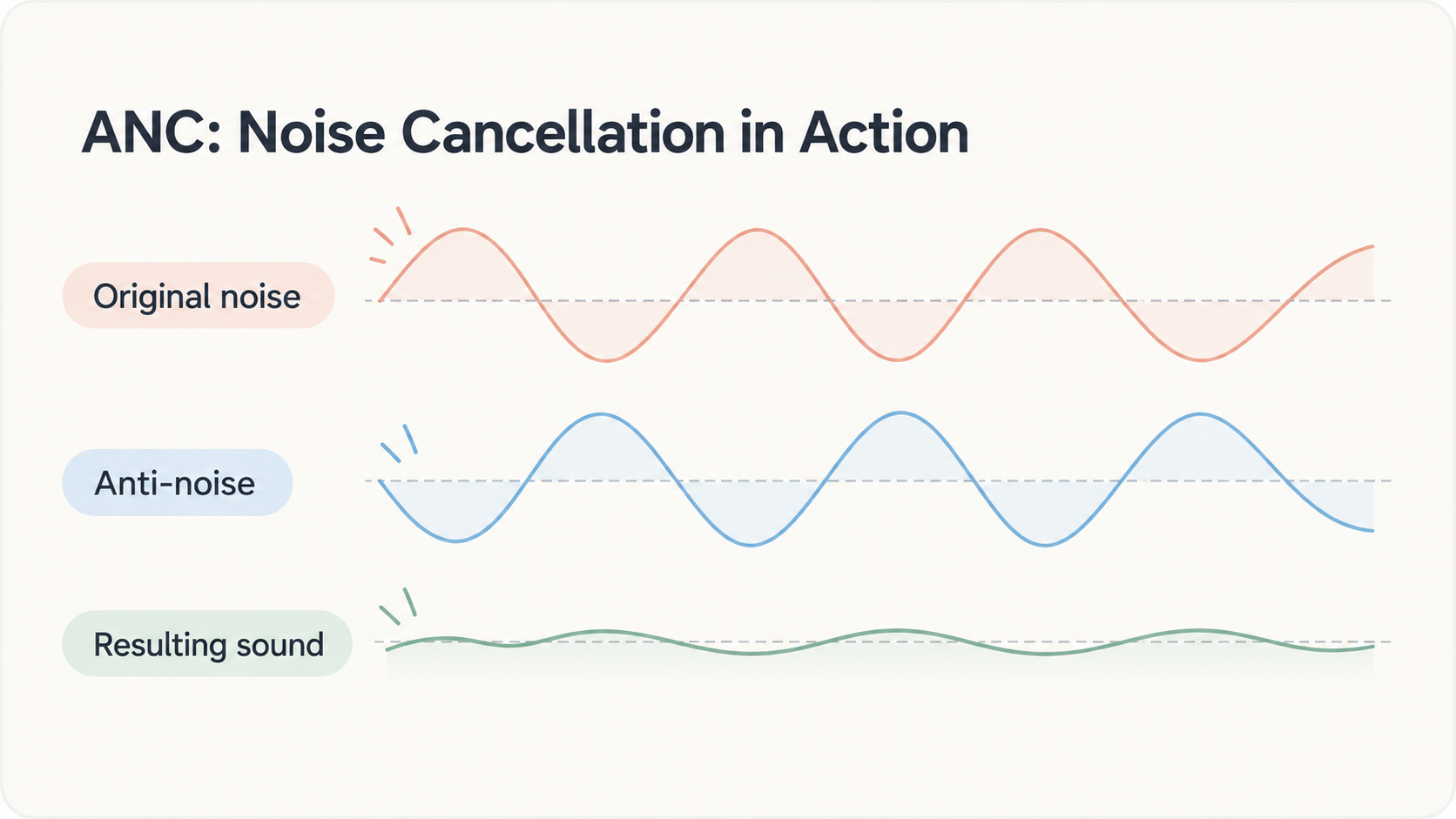
Active noise cancellation (ANC) uses microphones on the earbuds to pick up ambient noise. A processor then generates sound waves with the opposite phase to cancel out some of that sound.
This process repeats rapidly and continuously, and the earbuds keep adjusting the noise-canceling signal as the surrounding sounds change. ANC therefore may not completely cancel out external noise, because it is difficult to keep the amplitude, timing, and phase of the sound waves perfectly matched at all times. [2]
3. Why Does ANC Usually Work Better on Low-Frequency Noise?
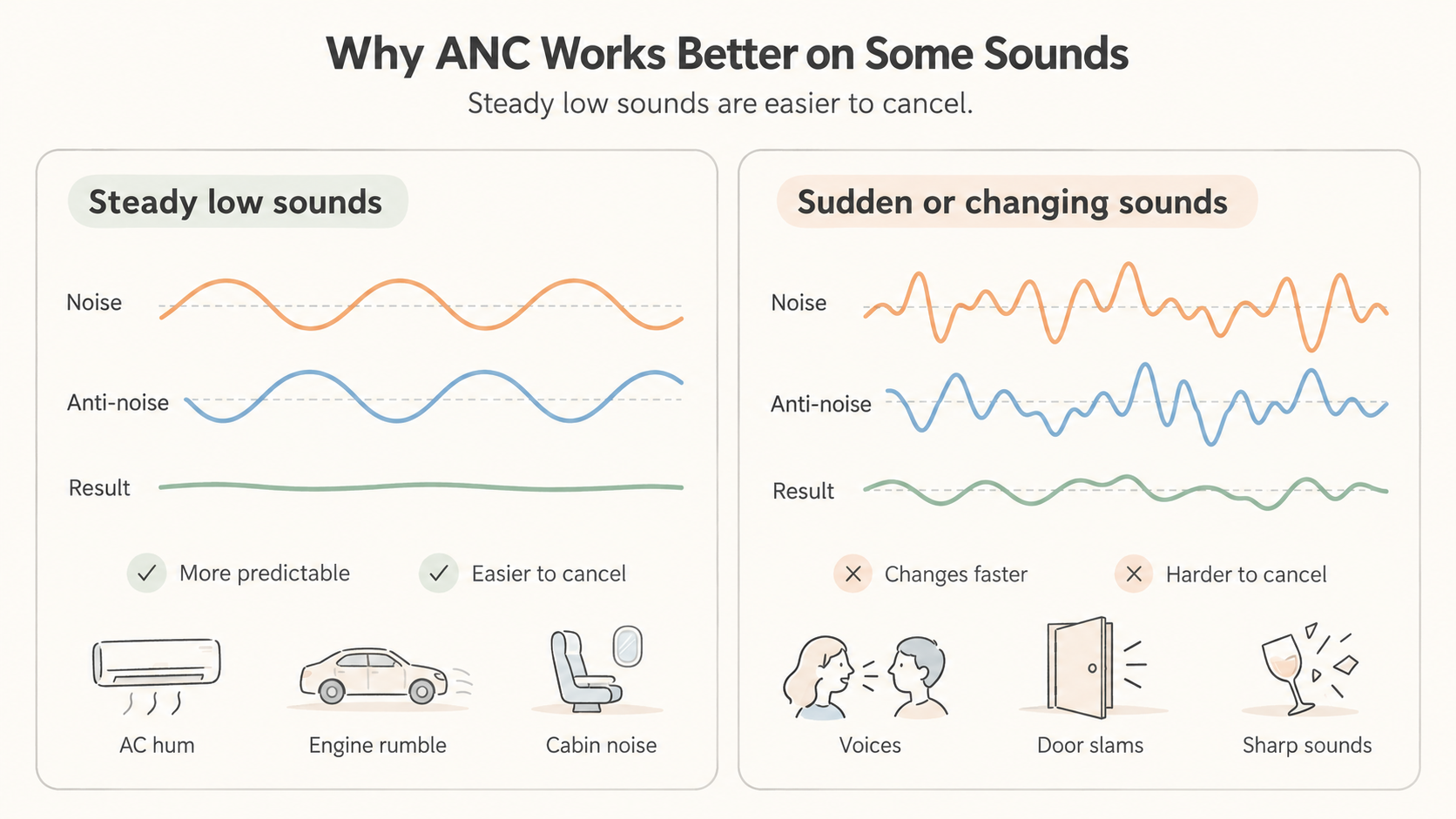
Low-frequency sounds have longer cycles. The relationship between timing and phase in sound waves helps explain why the same timing error produces a smaller phase error at a lower frequency. Noise from many air conditioners and engines also has relatively steady low-frequency components. IEEE's materials on active noise reduction identify low-frequency noise as an important application of this technology. [2] [3]
Examples include:
- The continuous, low-pitched hum of air conditioners and motors.
- The rumble of car engines and distant traffic.
- Relatively steady low-frequency background noise in an airplane cabin.
By contrast, voices, sudden door slams, and sharp impact sounds often contain more complex or rapidly changing frequency components. High-frequency sounds have shorter cycles, so the same timing error produces a larger phase error. This is one reason high-frequency sounds are harder to cancel. Based on these principles, active noise cancellation and passive noise isolation usually need to work together in practice; ANC alone is not enough. [2] [3]
4. How Does Sound Masking Help Block Out Noise While Sleeping?
The principles behind sound masking mainly involve two aspects:
First, auditory masking (Auditory Masking).
When two sounds occur at the same time, one may raise the hearing threshold at which you notice the other. Hearing science materials from the U.S. National Research Council note that sounds with similar frequency spectra are generally more likely to mask each other. When choosing a masking sound, you should therefore consider its frequency distribution, not just its overall volume. [3]
When adjusting a masking sound, try improving the fit of your ear tips first, then start at a lower volume. WHO notes that hearing risk is related to volume, listening duration, and frequency of exposure. Do not keep turning up the volume to completely cover ambient noise. [4]
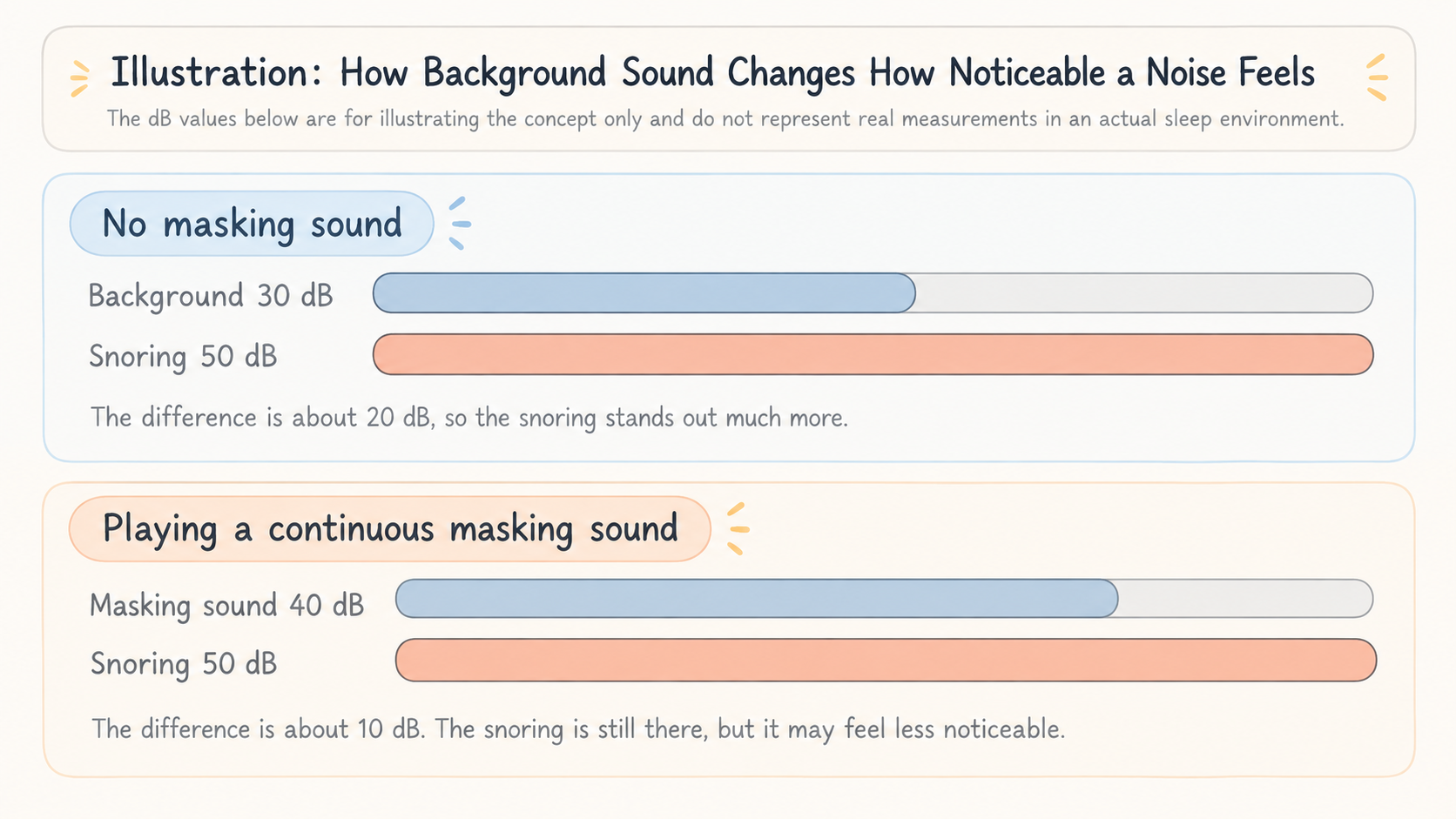
Second, making sounds feel less abrupt.
Sound masking is not simply about covering a quieter sound with a louder one. Continuous, steady background sound can reduce the contrast between environmental noise and the background. As a result, certain sudden noises may no longer stand out as much. A small-sample experiment by Brown Medical School and Rhode Island Hospital also found that, under simulated ICU noise conditions, white noise narrowed the difference between background and peak sound levels and reduced arousals from sleep.
5. What Is the Best Noise for Sleep: White Noise, Pink Noise, or Brown Noise?
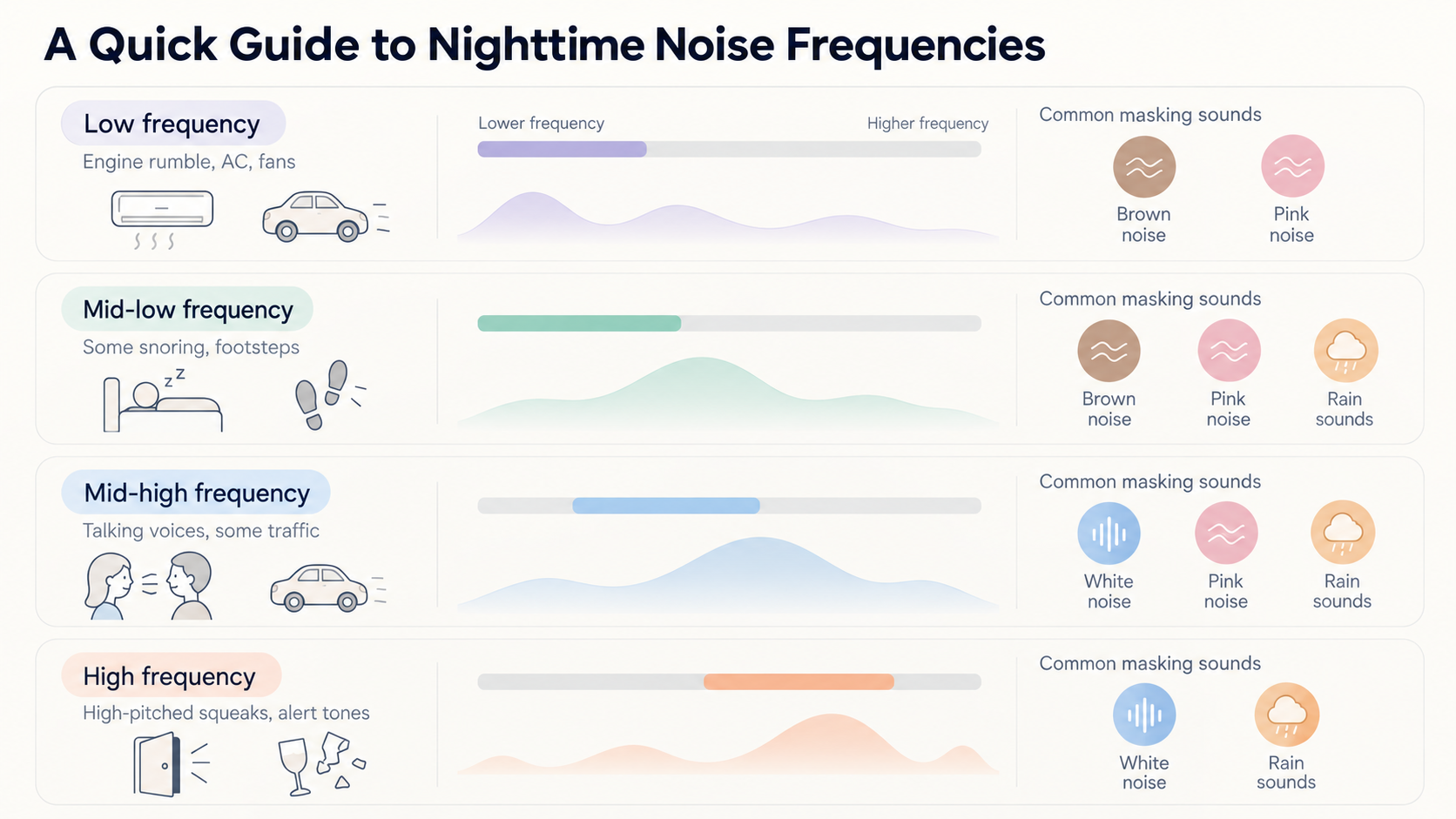
Different nighttime noises have different frequency characteristics, and real-world sounds often span multiple frequency ranges, so the masking sounds worth trying may differ as well. The chart below helps explain the frequency relationships between common sounds and masking sounds. [3]
6. Frequently Asked Questions (FAQ)
6.1 Why Can I Still Hear Noise with ANC On?
Why can I still hear noise with ANC on?
Because ANC cannot eliminate every sound. It is generally better at handling continuous, regular low-frequency noise, while voices, sudden knocking, and high-frequency sounds may still be noticeable. A poor ear tip seal can also affect overall noise reduction. Check your ear tip size and try combining ANC with sound masking. [2]
6.2 Does a Higher Noise Reduction dB Rating Mean Better Sleep Earbuds?
Does a higher advertised noise-reduction rating in decibels mean sleep earbuds actually work better?
Not necessarily. An advertised claim of "up to X dB of noise reduction" needs to be understood in the context of the test frequency, test conditions, and fit. It does not directly mean that every sound in your bedroom will be reduced by X dB. NIOSH notes that even the Noise Reduction Rating (NRR) on hearing protector packaging may not reflect the attenuation each person actually receives. NRR and the peak ANC figures advertised for consumer earbuds are different metrics and cannot be used interchangeably. When comparing sleep earbuds, also consider how they perform against your main noise source, how well they actually fit, and how comfortable they are for side sleeping—not just the highest number.
6.3 Do Sleep Earbuds Still Block Noise When the Battery Dies?
Can sleep earbuds still provide noise isolation when the battery dies?
They may still provide some passive noise isolation, but active noise cancellation and sound masking will stop. Passive noise isolation relies on the earbuds' physical structure and seal, so it does not require battery power. As long as the earbuds still fit well, they may continue to reduce some outside sound. ANC and masking sound playback, however, need power. If you want to reduce noise disturbances throughout the night, check battery life on a single charge under the conditions you will actually use, such as ANC on and audio playing, rather than looking only at total battery life including the charging case. [2]
6.4 Can Sleep Earbuds Block Out Traffic Noise Through a Bedroom Window?
Can sleep earbuds reduce traffic noise coming through a bedroom window?
They can reduce some traffic noise, but the results depend on the type of sound. Sleep earbuds with ANC are generally more helpful for the continuous rumble of traffic [2]; you should not expect the same noise reduction for sudden honking or screeching brakes. Start by adjusting the ear tips to maintain a good seal, then turn on ANC and add a low-volume masking sound if needed. Closing the windows and improving the seals around them can also help reduce noise entering the bedroom.
6.5 Can Sleep Earbuds Block Out Upstairs Footsteps?
Can sleep earbuds block out your upstairs neighbors' footsteps?
Sleep earbuds may reduce some footstep noise, but it is difficult to make the sound of people walking upstairs disappear completely. Footsteps are impact noise, which can travel through floors and walls and then radiate sound into a room. Materials from the National Research Council of Canada also note that the impact noise heard downstairs is related to the floor structure and floor covering materials. [5] Earbuds can reduce some of the sound reaching your ears, but they cannot eliminate the building's vibrations. For sounds you can still hear, you can try low-volume masking with a good ear tip seal. If you can also clearly feel the bed or floor vibrating, you will need to address the noise source and vibration isolation in the building as well.
6.6 Can sleep Earbuds Block Out Snoring?
Can sleep earbuds block out snoring?
They can reduce some snoring, but they cannot guarantee complete isolation. Snoring is not a single sound at a fixed frequency: a university research team's analysis of different types of snoring found differences in their spectral patterns. Based on the principles of active noise cancellation and auditory masking, you can try combining passive noise isolation, ANC if supported, and low-volume sound masking to reduce some snoring disturbances. However, this is a usage suggestion based on those mechanisms, not a guarantee that everyone will get the same results. [2] [3]
7. References
[1] WHO Regional Office for Europe: Noise. Environmental noise may disturb sleep.
[2] IEEE (Institute of Electrical and Electronics Engineers): Active noise reduction. Destructive interference, electronic active control, and low-frequency applications.
[3] U.S. National Research Council / National Academies Press: Basics of Sound, The Ear, and Hearing (2005). Sound waves, the relationship between phase and timing, and why sounds with similar frequency spectra are more likely to mask each other; see pages 42–44 and 51–52.
[4] World Health Organization (WHO): Deafness and hearing loss: Safe listening. The relationship between listening volume, duration, frequency of exposure, and hearing risk.
[5] National Research Council of Canada (NRC Canada): Controlling the Transmission of Impact Sound through Floors (2000). The relationship between impact noise such as footsteps, floor structure, and floor covering materials; only the acoustic principles are cited here, not outdated building codes.