Why 4-6 Breathing May Help You Fall Asleep
Feeling tired doesn’t always mean your body is ready for sleep. This article explores how 4-6 breathing may help you relax and fall asleep faster through changes in heart rate, cardiovascular feedback, and a shift in attention.

Tired but Can’t Sleep? Understanding Bedtime Arousal
Falling asleep depends on more than how tired you are. It also depends on your body’s level of arousal [1]—a useful starting point for understanding breathing exercises for sleep.
When you’re under stress, feeling tense, or unable to stop thinking, your body may respond in several ways:
Your heart rate speeds up.
Your breathing becomes faster or less regular.
Your muscles tense up.
You become more sensitive to sounds around you and sensations in your body.
These responses involve the autonomic nervous system, neuroendocrine activity, and the brain’s alertness networks. The sympathetic nervous system helps mobilize the body to respond to stress, while the parasympathetic nervous system supports rest, digestion, and other restorative processes. But these systems don’t operate as a simple on/off switch, and sleep does not completely shut down the sympathetic nervous system.
You can also learn about NSDR for sleep.
How Slow Breathing May Reduce Physiological Arousal Before Bed
When you begin breathing slowly and regularly, without forcing it, the changes in heart rate linked to breathing also change. Cardiovascular reflexes and autonomic regulation adjust along with them. [3]
Some studies have found that slow breathing can lower heart rate, reduce certain measures of physiological arousal, and ease feelings of tension.
This offers one way to understand what may be happening:
By adjusting activity in the heart, lungs, and autonomic nervous system, slow breathing may help the body move from a state of heightened physiological arousal toward a calmer one. [2]
It doesn’t send the brain an absolute “shut down” command. Rather, it may reduce some of the interference that ongoing arousal creates when you’re trying to rest.
Breathing and Heart Rate: How the Vagus Nerve Helps Regulate the Heart
Even when you’re lying quietly, the time between heartbeats isn’t exactly the same from one beat to the next.
For example, one interval might last 0.85 seconds and the next 0.91 seconds. This natural variation in the time between heartbeats can be described using heart rate variability (HRV).
Some of that variation is directly linked to breathing. It’s called respiratory sinus arrhythmia (RSA).
Typically:
Your heart rate tends to increase when you inhale.
Your heart rate tends to decrease when you exhale.
One important reason is that breathing changes how the vagus nerve regulates the heart. The vagus nerve is a major part of the parasympathetic nervous system and can slow the heart rate. When you inhale, its slowing effect on the heart often temporarily weakens, allowing the heart rate to rise. When you exhale, that effect returns or becomes stronger, and the heart rate falls. [3]
How the Baroreflex Links Blood Pressure and Heart Rate
Key mechanisms: the baroreflex and the nucleus tractus solitarius (NTS)
As breathing slows, changes in pressure inside the chest and in blood circulation also become slower and more rhythmic, producing corresponding fluctuations in blood pressure.
Baroreceptors in the blood vessels detect these changes and send signals to the nucleus tractus solitarius (NTS) in the brainstem. [3]
The NTS regulates heart rate and blood vessel activity through the autonomic nervous system. When blood pressure rises, it typically strengthens the vagus nerve’s slowing effect on the heart, reducing heart rate. When blood pressure falls, the response generally goes in the opposite direction. [3]
Slow breathing creates a rhythmic feedback interaction among breathing, blood pressure, and heart rate. Near the resonance frequency, this interaction may become stronger.
This regulation may be accompanied by a lower average heart rate and less physical tension, helping reduce physiological arousal before bed and creating more favorable conditions for falling asleep.
What Is Resonance Breathing? How Breathing Rhythms Interact With Cardiovascular Feedback
Breathing itself affects pressure inside the chest, the return of blood to the heart, how the heart fills, and changes in blood pressure.
When you deliberately slow your breathing, these changes follow the new breathing rhythm.
For many adults, breathing at close to six breaths per minute may bring the breathing rhythm near certain natural oscillation frequencies in the cardiovascular regulation system. [3]
At that point, breathing-related changes in heart rate can interact more strongly with the baroreflex. This is known as resonance frequency breathing.
How Can Resonance Increase Heart Rate Fluctuations and Potentially Support Sleep?
Key concept: resonance frequency breathing
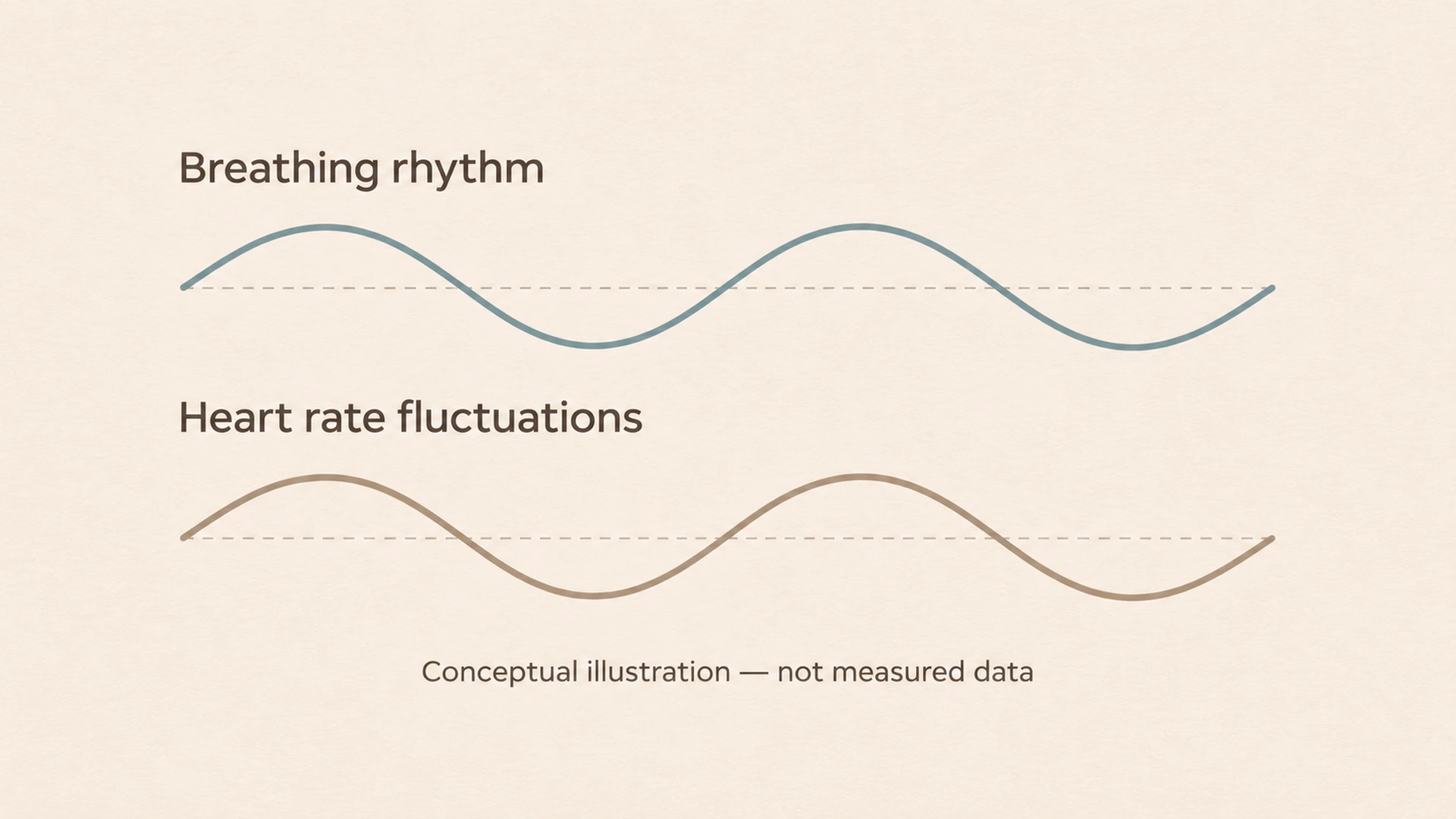
• Creating resonance: When breathing slows to about six breaths per minute, its rhythm approaches the natural oscillation frequency of the body’s cardiovascular feedback system. Because the baroreflex has a built-in feedback delay, breathing-related changes in heart rate and blood pressure may resonate with this feedback process. [3]
• Breathing directly regulates heart rate: During inhalation, the vagus nerve’s slowing effect on the heart typically weakens, and heart rate rises. During exhalation, that effect returns or strengthens, and heart rate falls. This is respiratory sinus arrhythmia (RSA).
• The baroreflex further regulates heart rate: Breathing changes pressure inside the chest and blood circulation, causing blood pressure to fluctuate. After baroreceptors detect these changes, the autonomic nervous system adjusts heart rate: rising blood pressure tends to slow the heart, while falling blood pressure tends to speed it up.
• Resonance amplifies heart rate fluctuations: During resonant breathing, when the breathing rate is close to the resonance frequency, breathing’s direct effect on heart rate and the baroreflex response may reinforce each other when their timing aligns. This can increase the size of the heart rate changes between inhalation and exhalation, raising certain HRV measures. [3]
Here’s an example. These numbers are only meant to illustrate the principle:
During ordinary breathing, heart rate might fluctuate between 68 and 72 beats per minute.
Near the resonance frequency, it might fluctuate between 62 and 78 beats per minute.
Even if the average heart rate remains 70 beats per minute, the variation between heartbeats is greater, so certain HRV measures increase. Resonance breathing doesn’t make the heart beat progressively slower. Instead, rhythmic coordination between breathing and the baroreflex amplifies the heart rate’s cyclical changes. [3]
Resonance breathing may make it easier to fall asleep by strengthening cardiovascular feedback and influencing stress regulation in the autonomic nervous system and brain. Importantly, resonance doesn’t happen after the first two mechanisms have finished. It results from those two regulatory processes interacting at a particular breathing rhythm. [3]
Back to Sleep: How 4-6 Breathing May Help Through Physiological Regulation and a Shift in Attention
Among breathing techniques for sleep, 4-6 breathing may help through two pathways: physiological regulation and a shift in attention. Physiologically, slow breathing changes how the vagus nerve regulates heart rate and interacts with the cardiovascular system through the baroreflex. At a breathing rate close to six breaths per minute, resonance may also occur, strengthening rhythmic feedback between heart rate and blood pressure. [3] These changes may contribute to stress regulation through the autonomic nervous system and related brainstem pathways, reducing physiological arousal before bed. Psychologically, focusing on a steady breathing rhythm can temporarily shift attention away from stress and worries, easing the mental tension that comes with repetitive thinking. So 4-6 breathing doesn’t directly put the brain to sleep. Instead, by easing physical tension and mental alertness, it may reduce the interference caused by excessive arousal and make it easier to drift off naturally.
Breathing is only one part of winding down. If noise, light, or temperature also disturb your rest, take a closer look at your bedroom sleep environment.
Final Thoughts
There’s more to 4-6 breathing than simply slowing your breath. It gives you a rhythm you can consciously adjust to influence processes your body normally regulates automatically. Breathing shapes changes in heart rate and interacts with cardiovascular feedback. It also gives your attention somewhere to rest, offering a momentary break from repetitive thoughts.
This brings us back to the opening question: feeling tired means you need rest, but it doesn’t mean your body’s alertness has settled. Sometimes, the transition from fatigue to sleep needs a period of relaxation. Slow, comfortable breathing may be a starting point for that transition.
References
- [1] Jerath, R., Beveridge, C., & Barnes, V. A. (2019). Self-Regulation of Breathing as an Adjunctive Treatment of Insomnia. Frontiers in Psychiatry, 9, 780. DOI: 10.3389/fpsyt.2018.00780.
- [2] Zaccaro, A., Piarulli, A., Laurino, M., Garbella, E., Menicucci, D., Neri, B., & Gemignani, A. (2018). How Breath-Control Can Change Your Life: A Systematic Review on Psycho-Physiological Correlates of Slow Breathing. Frontiers in Human Neuroscience, 12, 353. DOI: 10.3389/fnhum.2018.00353.
- [3] Lehrer, P. M., & Gevirtz, R. (2014). Heart rate variability biofeedback: how and why does it work?. Frontiers in Psychology, 5, 756. DOI: 10.3389/fpsyg.2014.00756.