Can Listening to White Noise All Night Damage Your Hearing?
Whether listening to white noise all night can damage your hearing depends mainly on sound level, frequency characteristics, and cumulative exposure time. For most adults, the risk of hearing damage is very low when the volume stays within a reasonable range, such as 30–50 dBA, even when it plays continuously for 8 hours each night. This article explains these issues from the perspectives of acoustics, physiology, and pathology, and helps you understand how to use white noise safely to improve sleep.
Many people play white noise at bedtime to mask traffic, noisy neighbors, or a partner’s snoring. Some even wear headphones every night and listen for seven or eight hours straight. But when this continuous sound becomes a daily habit, can it cause cumulative hearing damage? Are your ears still affected by sound while you sleep? To answer these questions, we first need to understand the physical properties of white noise and how sound affects the auditory system.
What Is White Noise?
White noise is broadband noise with equal power spectral density per unit of frequency bandwidth. Put simply, within its effective frequency range, every frequency interval of the same width contains the same amount of sound energy. Because higher-frequency octaves cover a wider frequency range, white noise has relatively more high-frequency energy than pink noise or brown noise. That gives it a brighter, sharper sound, similar to TV static.
White noise helps with sleep primarily through sound masking. A continuous, relatively steady background sound can reduce the contrast between sudden environmental noises and the background, making disruptive sounds less noticeable and potentially reducing noise-related nighttime awakenings.
How Does Sound Affect Your Auditory System?
When sound waves enter the ear canal, they cause the eardrum to vibrate. The three tiny bones in the middle ear transmit these vibrations to the cochlea in the inner ear. Fluid movement inside the cochlea then sets the basilar membrane in motion, bending the stereocilia on top of the hair cells. This opens mechanically sensitive ion channels and converts mechanical vibrations into electrical signals. The auditory nerve then carries this information to the brain, allowing us to perceive sound. [1]
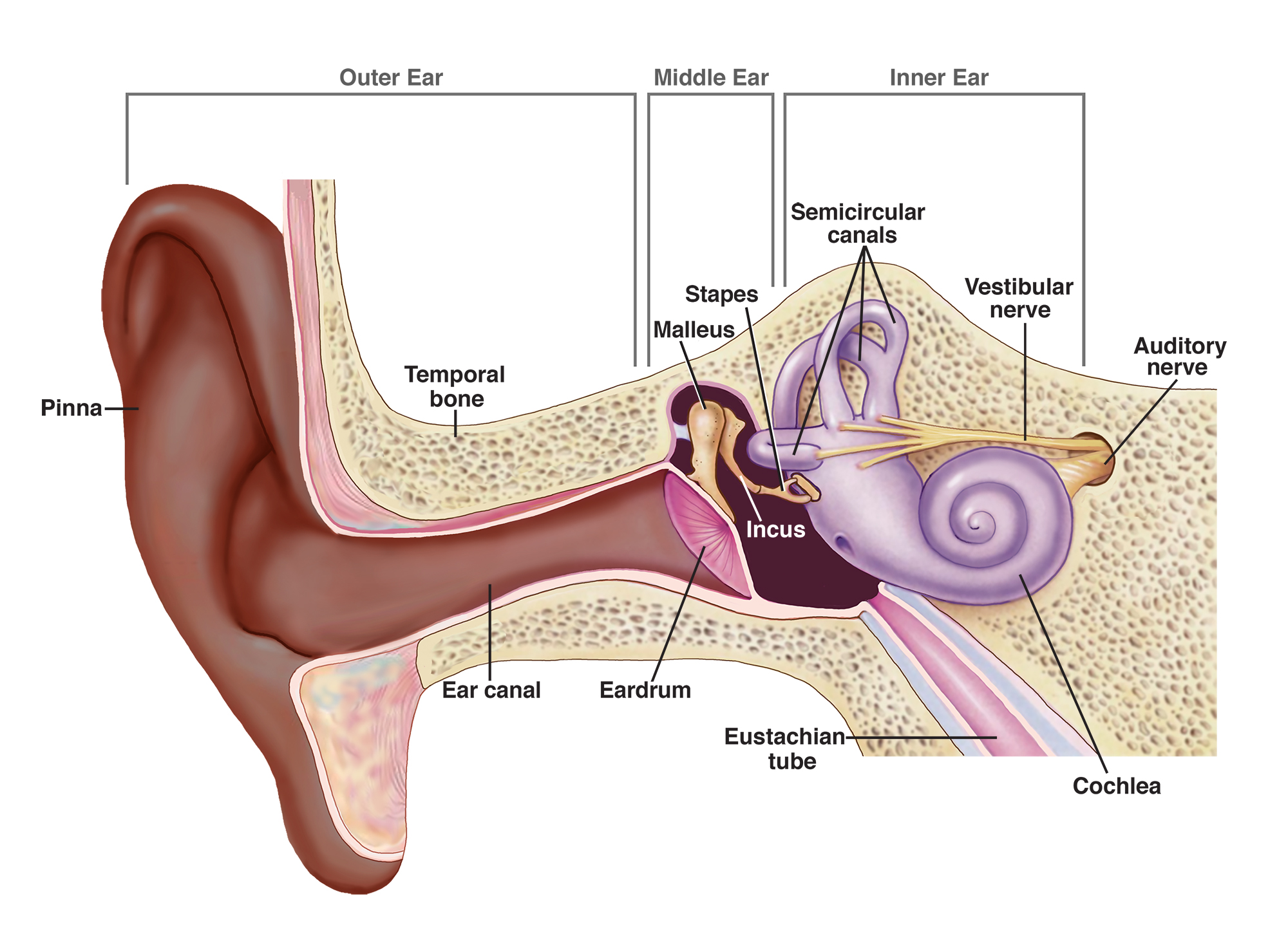
Sound travels through the outer and middle ear to the cochlea, then along the auditory nerve to the brain.
Source: NIH/NIDCD [1].
The cochlea is also organized by frequency: the region near its base responds mainly to high-frequency sounds, while the region near its apex responds mainly to low-frequency sounds. [1] Because white noise contains a broad range of frequencies, it can stimulate multiple regions of the cochlea that respond to different frequencies.
Can noise damage your hearing while you sleep?
During sleep, the way the brain processes external sounds changes, and our conscious awareness of sound and ability to respond decrease. But sound waves can still travel through the outer and middle ear to the cochlea and trigger physiological responses in the hair cells. Even when you are asleep, excessive sound exposure can still damage the auditory system.
How Can Prolonged Noise Exposure Damage Your Hearing?
When sound exposure exceeds what the auditory system can tolerate, normal physiological responses can turn into tissue damage. This is known as noise-induced hearing loss and mainly involves the following three mechanisms. [2]
Mechanical Damage
High-intensity sound waves cause excessive vibration inside the cochlea, placing mechanical stress on hair cells and their stereocilia. When this stress exceeds what the cellular structures can withstand, stereocilia may become deformed or break, or the hair cells themselves may be damaged, disrupting the normal conversion of sound into electrical signals. This type of injury is particularly pronounced with extremely high-intensity sound exposure. [2]
Metabolic Stress and Oxidative Damage
Continuous excessive sound exposure increases energy use and the metabolic demands on cochlear cells. When the cells produce more reactive oxygen species than their antioxidant systems can handle, oxidative stress can occur, damaging cell membranes, proteins, and mitochondria. This can ultimately cause hair cells to malfunction or die. It is also one of the key mechanisms by which repeated excessive sound exposure over time can cause cumulative hearing damage. [2]
Cochlear Synaptopathy
In addition to damaging the hair cells themselves, excessive sound exposure may damage the synaptic connections between hair cells and the auditory nerve. This disrupts the transmission of sound information to the brain, preventing it from arriving fully and accurately. Because human cochlear hair cells lack an effective ability to regenerate naturally, hearing may be difficult to restore once permanent damage occurs. [2] [3]
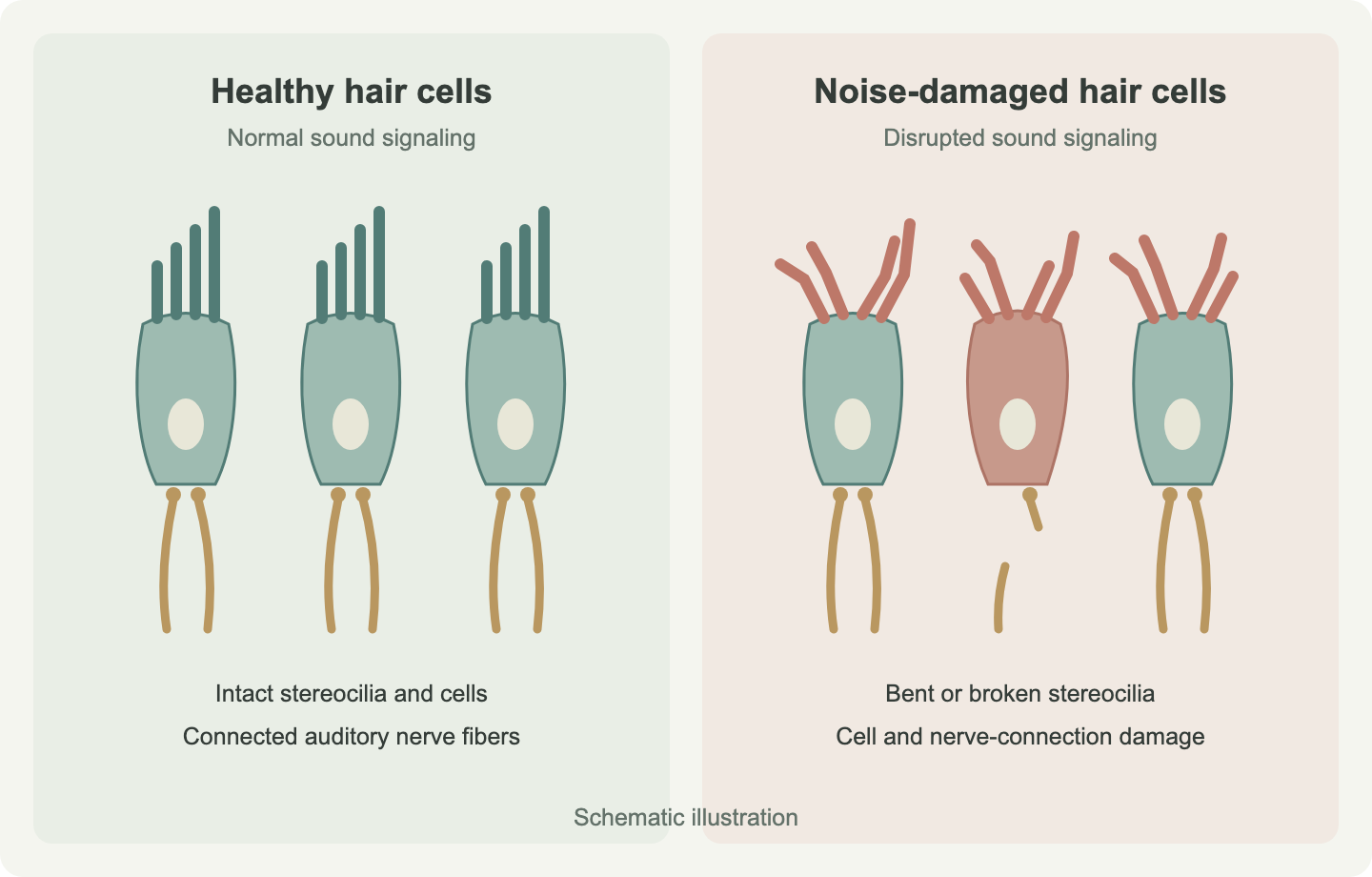
Schematic comparison of healthy hair cells and noise-related damage to stereocilia, cells, and nerve connections.
Illustration based on: Le et al. (2017) [2].
How Loud Is Too Loud for White Noise?
According to safe-listening guidance from the National Institute on Deafness and Other Communication Disorders (NIDCD) and the World Health Organization (WHO), the risk of hearing damage varies considerably with sound level:
- At or below 70 dBA: Even with prolonged exposure, noise-induced hearing loss is generally unlikely. [3]
- 70–80 dBA: The risk of hearing damage is relatively low, but exposure duration and cumulative sound exposure still need to be considered.
- At or above 80 dBA: The risk of hearing damage increases as sound level rises and exposure lasts longer, making stricter limits on exposure time necessary. [4]
For an everyday comparison, normal conversation is about 60 dBA, while a running vacuum cleaner is about 70–80 dBA. Listening to white noise follows the same hearing-safety principles as listening to music through headphones: listening for a long time does not necessarily damage your hearing. What matters is sound level and cumulative exposure. The headphone audio monitoring and high-volume alerts available on many smartphones are designed to help prevent excessive sound exposure. [4] So, for most adults, when the white noise actually reaching the ears stays at a low level of 30–50 dBA, noise-induced hearing loss is generally not a concern, even if it plays continuously for 8 hours each night.
How to Safely Listen to White Noise All Night?
- Keep the volume down: If you need white noise throughout the night, use the lowest volume that effectively masks environmental noise. Avoid turning it up excessively to drown out every outside sound. [4]
- Set an appropriate playback duration: If you only use white noise to help you fall asleep, you can set a sleep timer to reduce unnecessary sound exposure.
- Combine passive noise isolation with active noise cancellation: Using passive noise isolation and active noise cancellation (ANC) to reduce outside noise can lower the volume of white noise you need, reducing unnecessary sound exposure while maintaining its sleep benefits. [4]
- Consider your total sound exposure: Along with the white noise you play at night, account for sound exposure from daytime activities such as listening to music, commuting, and working. [4]
DUVA ONE sleep earbuds monitor environmental noise in real time and dynamically adjust white noise as nighttime noise changes. They reduce unnecessary sound stimulation when the surroundings are quiet and provide appropriate sound masking when noise occurs. DUVA ONE also offers a customizable sleep timer, allowing you to set playback duration to fit your sleep habits. By combining active noise cancellation (ANC) with passive noise isolation, DUVA ONE helps reduce reliance on high-volume white noise, meeting your sleep needs while reducing unnecessary sound exposure. Learn more about DUVA ONE sleep earbuds.
Frequently Asked Questions
Is it safe to listen to white noise every night?
Yes. For most adults, playing white noise at a low volume of 30–50 dBA every night carries a very low risk of hearing damage. Long-term white noise use does not mean long-term hearing damage. What matters is the sound level actually reaching your ears and your cumulative exposure.
How do I know if my white noise is too loud?
How can you tell if your white noise is too loud? If you use a white noise machine, you can use a sound level meter to measure the sound at your pillow. If you use headphones, you can check the headphone audio level data available on compatible devices. For white noise that plays all night, start by trying 30–50 dBA.
Is pink noise or brown noise safer than white noise?
Not necessarily. Pink noise and brown noise have relatively less high-frequency energy and sound gentler. But a gentler sound is not necessarily safer for your hearing. The key to protecting your hearing is still controlling the actual playback volume and exposure duration.
Final Thoughts
Listening to white noise all night does not necessarily damage your hearing. For most adults, long-term use of low-volume white noise carries a low risk of hearing damage. The real concern is prolonged, repeated exposure to loud sound, which may damage cochlear hair cells and auditory nerve connections and cause irreversible hearing loss. [2] [3]
If you regularly listen to white noise all night, use the lowest volume that effectively masks environmental noise rather than trying to block out every outside sound. If you only need it to fall asleep, you can set a sleep timer. If you need it throughout the night, combining active noise cancellation with passive noise isolation can reduce reliance on high-volume white noise. Also consider your cumulative sound exposure during the day.
White noise itself is not the main cause of hearing damage. Excessive sound levels and exposure time are what matter. Managing these two factors can help you benefit from white noise for sleep while reducing the potential risk of hearing damage.
References
- [1] National Institute on Deafness and Other Communication Disorders. How Do We Hear? Updated March 16, 2022. NIH/NIDCD. Ear anatomy illustration: NIH/NIDCD. Public domain under the NIDCD copyright policy. NIDCD copyright policy.
- [2] Le TN, Straatman LV, Lea J, Westerberg B. Current insights in noise-induced hearing loss: a literature review of the underlying mechanism, pathophysiology, asymmetry, and management options. Journal of Otolaryngology – Head & Neck Surgery. 2017;46:41. doi:10.1186/s40463-017-0219-x.
- [3] National Institute on Deafness and Other Communication Disorders. Noise-Induced Hearing Loss. Updated April 16, 2025. NIH/NIDCD.
- [4] World Health Organization. Deafness and hearing loss: Safe listening. March 6, 2026.