


How Does Sound Masking Work? The Science Behind Sleep Sounds
Learn how background sounds make nighttime noise less noticeable—and why louder isn't always better.
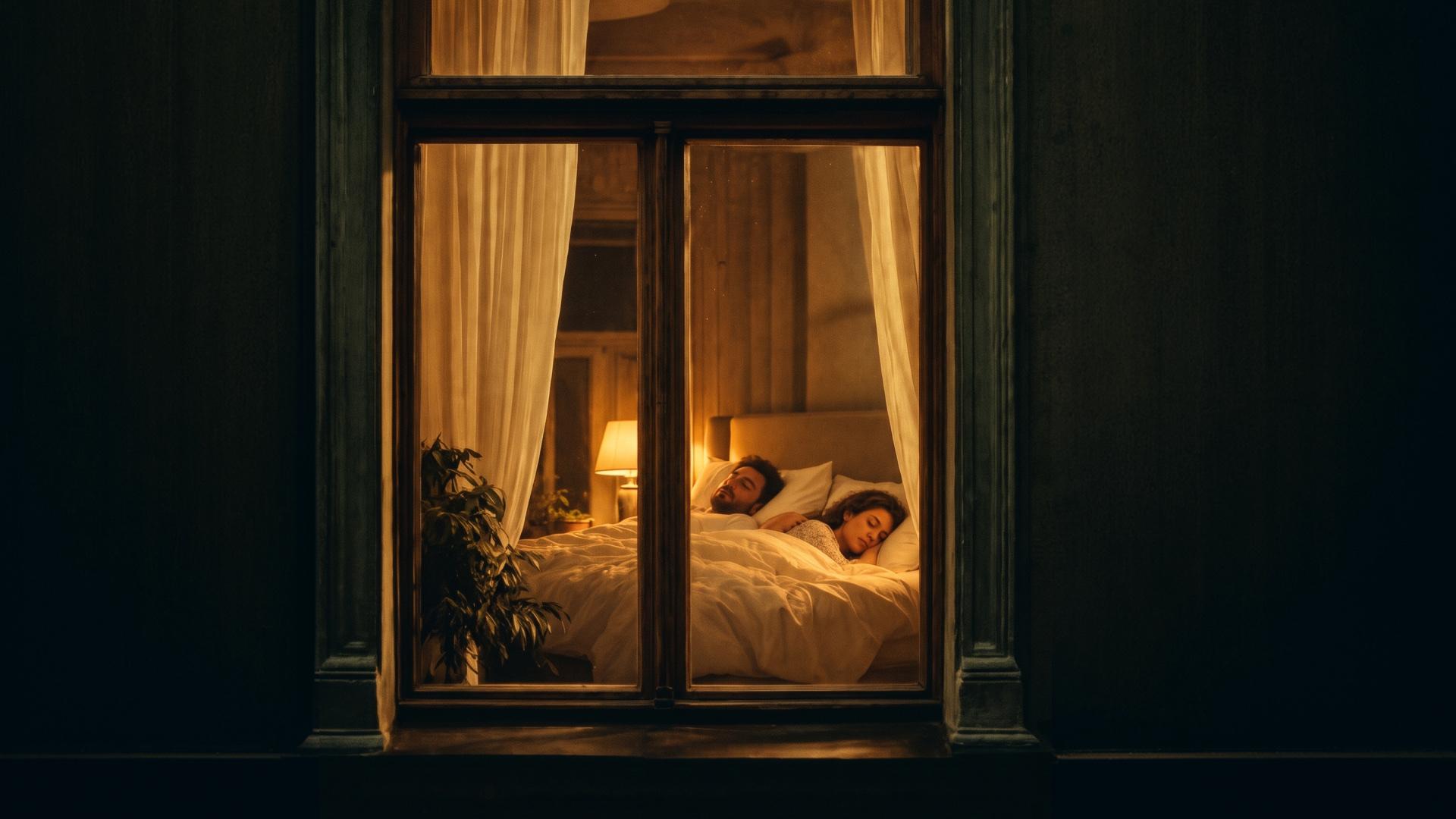
Snoring and traffic can stand out in a quiet room. A fan or gentle rain sounds may make them less noticeable. That is sound masking: it changes how much a noise stands out, not whether the noise exists.
The type and volume of the masking sound matter, as does the noise you want to mask. [1]
How Does Sound Masking Work?
A black dot stands out on plain white paper but is harder to notice against a pattern. Sound masking works in a similar way.
One sound can make another harder to detect when they occur together, especially if their frequencies overlap. This is simultaneous masking. It raises the auditory detection threshold—the lowest sound level you can detect. [1]
What Makes Sound Masking More Effective?
Sound masking is not simply about using a louder sound to cover a quieter one. Its effectiveness depends mainly on three factors:
Sound Frequency: Masking is usually more pronounced when the masking sound and the target noise have similar frequencies or overlapping frequency ranges.[1] For example, deep brown noise may be better suited to masking some low-frequency environmental noise.
Relative Volume: The volume of the masking sound affects how easily the target noise can be detected, but turning up the volume should not be the only way to pursue stronger masking. WHO notes that volume, listening duration, and frequency of exposure all affect hearing risk. [2]
Changes in Sound (Sound Characteristics): Continuous, steady background sound often makes some environmental noises less noticeable, while a door suddenly slamming, a sharp impact, or snoring that varies widely in volume may still be clearly audible. In a 2005 laboratory study, 4 participants completed all three conditions; adding white noise to recordings of ICU noise reduced sleep arousals. The researchers attributed this to the smaller difference between background sound and noise peaks. [3]
Sound masking does not lower the sound pressure level of environmental noise. It may increase the total sound level. It changes how you perceive noise, not the noise itself. [1]
What Types of Sounds Are Best for Sound Masking?
White noise, pink noise, and brown noise. Although all three are called “noise,” they sound quite different: white noise has a steady hissing quality, pink noise sounds softer, and brown noise has a distinctly deep, rumbling quality. The key to these differences lies in how sound is distributed across frequencies
Put simply, lower-frequency sounds generally have a lower pitch, such as the hum of an air conditioner or a distant engine, while higher-frequency sounds generally have a higher pitch, such as an electronic alert or a faint hiss. Most noises we hear in everyday life do not consist of just one frequency; they combine sounds at many different frequencies. [1]
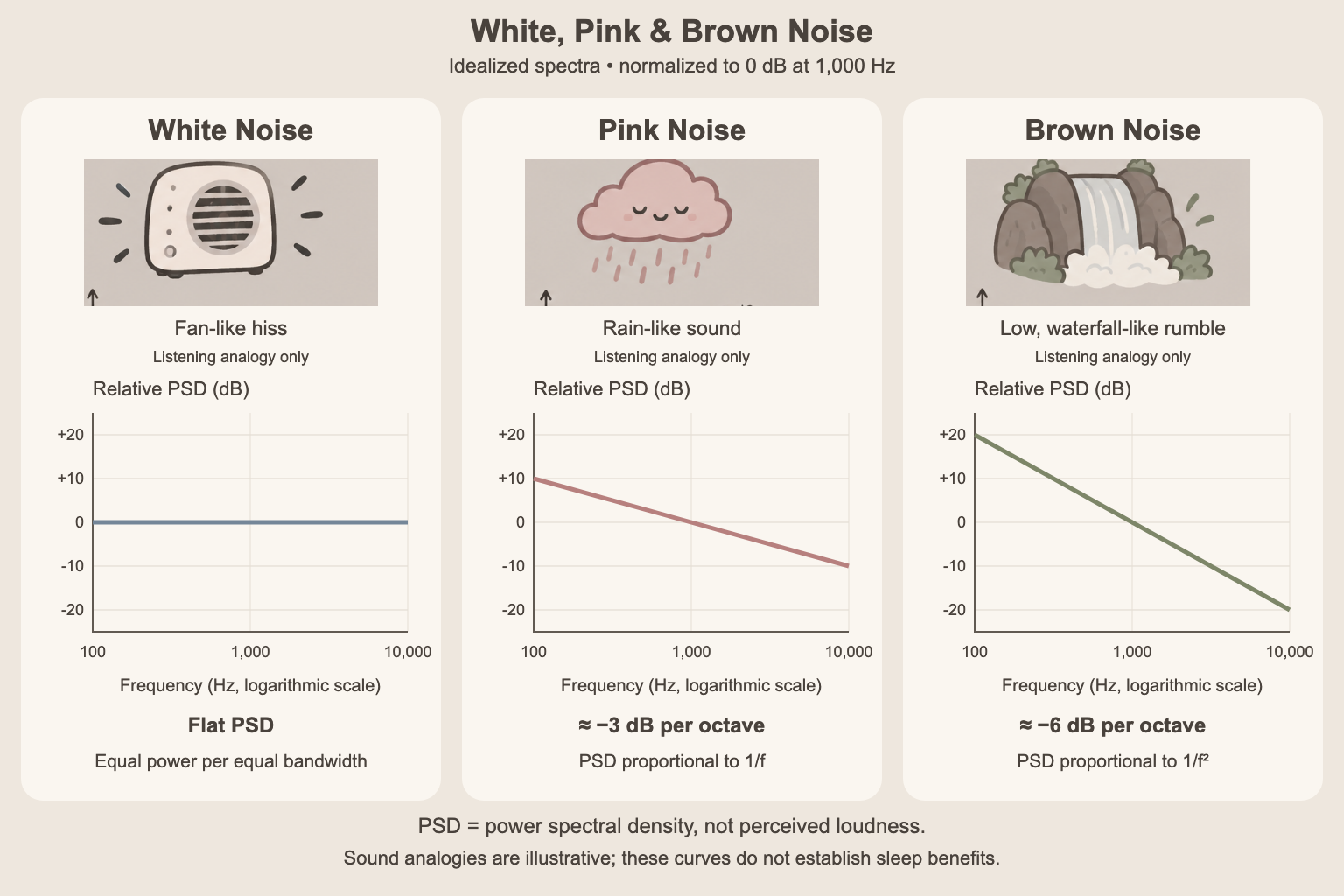
Figure note: The curves above should be understood as relative power spectral density, not perceived loudness. White noise has the same average power within equal frequency bandwidths; the power spectral density of pink noise and brown noise decreases by approximately 3 dB and 6 dB, respectively, for each octave increase in frequency. The natural sounds shown are listening analogies, and the curves do not represent sleep benefits.
How to Use Sound Masking for Sleep
Now that you understand the characteristics of different masking sounds, how can you actually use them for sleep? The key is not to find the loudest masking sound, but to choose a sound that suits your current noise environment and play it at the lowest possible volume.
Match the Sound to the Noise
Different environmental noises have different frequency characteristics, so the masking sounds that suit them may also differ. For example, if you are bothered by the low hum of an air conditioner or distant traffic rumble, you can try brown noise, which has more low-frequency content. For neighbors talking, mild snoring, or other sounds that contain a mix of frequencies, you can try white noise, pink noise, or steady rain sounds.
Keep the Volume Low and Comfortable
Do not rely solely on turning up the volume to achieve stronger masking. If you keep raising the volume to completely cover snoring, background sound intended to help you sleep may become another source of disturbance. Start at a low volume and adjust it until environmental noise is less noticeable and you feel comfortable. If you only need help falling asleep, you can try setting a shutoff timer. If you play sound all night, consider the actual volume, playback duration, and frequency of exposure together. Do not assume that headphones or low-volume playback will leave your ability to detect important alarms unaffected; test smoke alarms regularly according to the manufacturer’s instructions.
Combine Masking with the Noise Control Your Earbuds Support
Sound masking and active noise cancellation (ANC) do not conflict with each other; they can work together.
ANC can reduce some continuous low-frequency noise, such as air conditioner hum or traffic rumble. [5] Sound masking uses background sound to make other sounds less noticeable. [1]
WHO notes that well-fitted, noise-canceling headphones can reduce the need to raise playback volume.[2] Results depend on the noise, fit, and settings.
Using DUVA ONE for Personal Sleep Audio
DUVA ONE combines acoustic sealing, passive noise isolation, Enhanced Noise Reduction, and sleep sound masking. Start with a comfortable seal, then choose a sleep sound and keep its playback level low. Enhanced Noise Reduction is the DUVA feature name used here; do not read it as a claim of ANC. [9]
Frequently Asked Questions
Does Sound Masking Really Help You Sleep?
Sound masking may help people who are easily disturbed by environmental noise, but making noise less noticeable does not necessarily mean better sleep. A systematic review published by Riedy and colleagues in 2021 included 38 studies and found results ranging from improved sleep to disrupted sleep. The overall quality of evidence supporting continuous noise for improving sleep was rated very low (GRADE: very low). [6] A 2026 laboratory crossover study involving 25 healthy adults found that playing pink noise at 50 dBA throughout the night reduced REM sleep compared with a quiet control condition. [7] The 50 dBA finding concerns that study’s all-night exposure, not every masking setup. Judge a sound by whether it helps you settle and how you feel afterward, rather than assuming continuous noise always improves sleep.
Can Sound Masking Completely Block Out Snoring?
Snoring can span a range of frequencies and change in loudness, so one fixed sound may leave some snores audible. A study of simulated and nighttime snoring found different frequency distributions for different snoring types. [8] For your own setup, try good passive noise isolation and low-volume masking, adding ANC only if supported. This practical choice follows the acoustic principles, not an earbud test in that snoring study. [1] [5]
Is Brown Noise Better Than White Noise for Sleep?
Not necessarily. White noise spreads power evenly across equal frequency bands[1], while brown noise emphasizes lower frequencies. Try a sound that makes your particular disturbance less noticeable at a comfortable volume. Frequency content helps explain masking; it does not establish that brown noise improves sleep more than white noise.
Is It Safe to Listen to White Noise All Night?
Sounding comfortable is not enough to determine that all-night playback is safe. WHO notes that hearing risk depends on actual volume, listening duration, and frequency of exposure together.[2] Start at a low volume; if you only need help falling asleep, you can try a shutoff timer. Avoid continually raising the volume in an attempt to completely cover environmental sounds. During use, do not assume that important alarms will remain audible, and test smoke alarms regularly[4] according to the manufacturer’s instructions.
Can Sound Masking and ANC Work Together?
Final Thoughts
Start with the disturbance, not the color of noise: choose a sound that makes it less noticeable at a low, comfortable level. If you only need help settling down, try a timer. Stop or change the setup if the audio itself becomes distracting, and choose an arrangement that preserves the awareness you need for alarms or family members at night.
References
- [1] National Research Council. (2005). Basics of Sound, the Ear, and Hearing. In Hearing Loss: Determining Eligibility for Social Security Benefits, pp. 42–68. National Academies Press. DOI: 10.17226/11099. Cited pages: 43–44, 50–52.
- [2] World Health Organization. (2026, March 6). Deafness and hearing loss: Safe listening.
- [3] Stanchina, M. L., Abu-Hijleh, M., Chaudhry, B. K., Carlisle, C. C., & Millman, R. P. (2005). The influence of white noise on sleep in subjects exposed to ICU noise. Sleep Medicine, 6(5), 423–428. DOI: 10.1016/j.sleep.2004.12.004.
- [4] National Fire Protection Association. Smoke Alarms.
- [5] IEEE Technology Navigator. Active noise reduction.
- [6] Riedy, S. M., Smith, M. G., Rocha, S., & Basner, M. (2021). Noise as a sleep aid: A systematic review. Sleep Medicine Reviews, 55, 101385. DOI: 10.1016/j.smrv.2020.101385.
- [7] Basner, M., et al. (2026). Efficacy of pink noise and earplugs for mitigating the effects of intermittent environmental noise exposure on sleep. SLEEP, 49(5), zsag001. DOI: 10.1093/sleep/zsag001.
- [8] Herzog, M., et al. (2008). Frequency analysis of snoring sounds during simulated and nocturnal snoring. European Archives of Oto-Rhino-Laryngology, 265, 1553–1562. DOI: 10.1007/s00405-008-0700-2.
- [9] DUVA. Support: Noise Reduction and Sleep Sound Masking.