White Noise vs. Pink Noise: Benefits and How to Choose
White noise and pink noise are both popular choices for sleep, but they sound different and may suit different needs. White noise has a brighter, steady hiss, while pink noise sounds softer and deeper.
So which one should you choose? Let's explore their differences, what research says about sleep benefits, and how to find the right option for you.
What Is White Noise for Sleep?
White noise has equal average power within equal frequency bandwidths. It sounds like a steady hiss, similar to radio static.
Its main purpose during sleep is sound masking. It can make quieter, intermittent sounds less noticeable, such as distant conversations, hallway footsteps, light traffic noise, or faint household sounds. This makes it useful in shared apartments, hotels, or bedrooms where background noise is unpredictable.
However, white noise has limitations. Loud snoring, barking dogs, slamming doors, and sudden horns may still stand out. Deep, low-frequency vibrations from heavy traffic or machinery can also be difficult to mask at a comfortable volume.
White noise doesn't block sound like earplugs or active noise cancellation (ANC). It simply makes certain sounds less noticeable, and turning it up too loud may disturb sleep rather than help.
Benefits of White Noise
Improve sleep: In a small experimental study, broadband sound shortened the time to stage 2 sleep. [1] However, findings on continuous noise and sleep are mixed, and the evidence for improved sleep is of very low quality. [10]
Soothe babies: In a small trial, more newborns fell asleep within five minutes with white noise than without it. [2] In a small trial of infants with colic, white noise reduced diary-recorded crying time and increased sleep duration compared with swinging. [11]
Improve concentration: May support attention-related task performance in some people with ADHD. [3]
Relieve tinnitus discomfort: May make ringing or buzzing sounds less noticeable. [4]
Reduce distress during medical procedures: Some studies suggest it may reduce pain-related responses in infants. [5]
What Is Pink Noise for Sleep?
Pink noise contains energy across a wide range of frequencies, but its energy decreases as frequency increases. Compared with white noise, it sounds deeper and less hiss-like, often resembling steady rainfall or rustling leaves.
For sleep, pink noise can help mask quieter background sounds, such as distant traffic, low-level conversations, ventilation noise, or a fan running nearby. Its softer, deeper sound may also feel more comfortable than white noise for people who find high-frequency hissing distracting.
However, pink noise has limitations. Loud snoring, barking dogs, slamming doors, and sudden alarms can still be noticeable. Deep vibrations from heavy vehicles or machinery are also difficult to mask without raising the volume significantly.
Pink noise doesn't eliminate noise or guarantee better sleep. Its main advantage is providing a consistent background sound that some people find more pleasant, rather than being scientifically proven to improve sleep more than white noise.
Benefits of Pink Noise
Improve sleep: A small study found that pink noise increased the proportion of stable sleep estimated using cardiopulmonary coupling compared with quiet conditions. [6] However, findings on continuous noise and sleep are mixed, and the evidence for improved sleep is of very low quality. [10]
Promote relaxation: Its softer, deeper sound may feel more calming than white noise.
Support concentration: Research on white and pink noise suggests a small benefit on laboratory attention tasks in young people with ADHD or elevated ADHD symptoms, but poorer performance in those without ADHD. [3]
Enhance slow-wave activity: Precisely timed pink-noise stimulation may strengthen slow-wave activity during sleep. [7]
Support memory consolidation: Some studies suggest that precisely timed stimulation during sleep may improve certain memory outcomes. [7]
These findings concern precisely timed stimulation during sleep, not simply playing pink noise continuously overnight. They do not establish that an all-night pink-noise track will increase deep sleep or improve memory. [7]
The Difference Between White Noise and Pink Noise
White noise and pink noise distribute sound energy differently. White noise has equal energy per hertz. Wider high-frequency bands therefore contain more total energy, giving it a brighter hiss.
Pink noise has equal energy per octave. Its energy per hertz falls as frequency rises, so it sounds deeper and softer. Both cover many frequencies, but may mask different sounds more effectively.
Which Noise Should You Try for Your Sleep Situation?
The best choice depends on the sounds disturbing your sleep and your personal listening preferences.
Choose white noise if: You are frequently disturbed by faint conversations, footsteps, or occasional background sounds, and don't mind a steady hiss.
Choose pink noise if: You prefer softer, deeper sounds or find white noise too sharp. It's also worth trying if your bedroom has a steady, low-pitched hum.
Try both if: You're unsure which works better. Play each at a low, comfortable volume on different nights and notice whether you fall asleep comfortably or wake up because of noise.
Consider other solutions if: Loud snoring, slamming doors, or traffic still disrupt your sleep. White or pink noise alone may not be enough. Depending on the device, passive isolation or ANC can complement sound masking.
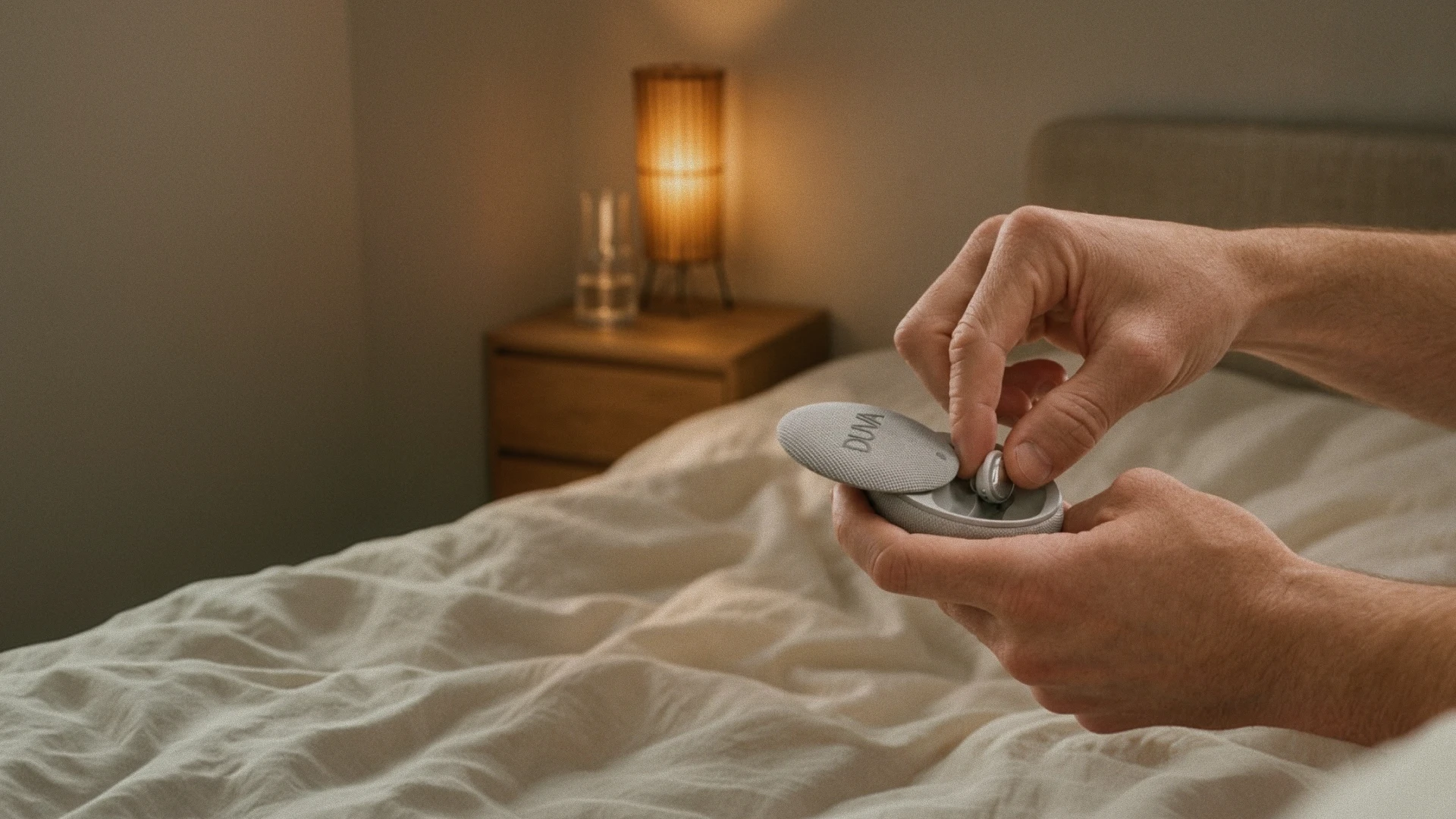
DUVA ONE supports acoustic sealing, passive noise isolation, Enhanced Noise Reduction, and sleep sound masking.
Frequently Asked Questions
Is Pink Noise Better Than White Noise for Deep Sleep?
The cited studies do not establish a head-to-head advantage for pink noise. A study of precisely timed pink-noise stimulation found increased slow-wave activity during stimulation intervals, but this does not show that continuous overnight playback increases deep sleep. [7] A separate systematic review found mixed results and very low-quality evidence for continuous noise improving sleep; it was not a direct white-versus-pink-noise deep-sleep trial. [10]
Is It Safe to Play White Noise or Pink Noise All Night?
Low volume alone does not establish that all-night playback is safe. Hearing risk depends on the sound level, listening duration, and how often you listen.[12] Keep playback low, avoid placing speakers close to your ears, and stop if it disturbs your sleep.
How Loud Should White Noise or Pink Noise Be for Sleep?
Use the lowest volume that makes distracting sounds less noticeable. There is no single ideal volume for everyone because listening distance, device type, and background noise levels vary. Avoid turning up the volume just to cover loud disturbances.
Can White Noise or Pink Noise Help with Tinnitus?
Both may help make tinnitus less noticeable by providing background sound. However, they do not treat its underlying cause. Evidence for the effectiveness of tinnitus sound-therapy devices is limited and of low quality. [9] If tinnitus is persistent or worsening, consider seeking medical advice. [4]
Is White Noise or Pink Noise Better for Babies?
The cited newborn trial compared white noise with no white noise, not with pink noise, so it cannot tell us which is better for babies. [2] Safety is particularly important: infant sleep machines can produce hazardous sound levels. Keep the sound low, place the machine as far from the baby’s head as possible, and use it only for a short time. [13]
Can You Use White Noise and Pink Noise Together?
Yes, but combining them is not necessarily better than using either one alone. Mixing the two changes the overall sound and may increase the total volume. If you enjoy the combination, keep the playback level comfortable and check whether it actually helps reduce nighttime disturbances.
Final Thoughts
Neither type is universally better for sleep. Choose the one that makes unwanted sounds less noticeable without becoming a distraction itself.
References
- [1] Messineo L, Taranto-Montemurro L, Sands SA, Oliveira Marques MD, Azabarzin A, Wellman DA. (2017). Broadband Sound Administration Improves Sleep Onset Latency in Healthy Subjects in a Model of Transient Insomnia.
- [2] Spencer JA, Moran DJ, Lee A, Talbert D. (1990). White noise and sleep induction.
- [3] Nigg JT, Bruton A, Kozlowski MB, Johnstone JM, Karalunas SL. (2024). Systematic Review and Meta-Analysis: Do White Noise or Pink Noise Help With Task Performance in Youth With Attention-Deficit/Hyperactivity Disorder or With Elevated Attention Problems?
- [4] National Institute on Deafness and Other Communication Disorders. Tinnitus.
- [5] Sağkal Midilli T, Ergin E. (2023). The Effect of White Noise and Brahms' Lullaby on Pain in Infants during Intravenous Blood Draw: A Randomized Controlled Study.
- [6] Zhou J, Liu D, Li X, Ma J, Zhang J, Fang J. (2012). Pink noise: effect on complexity synchronization of brain activity and sleep consolidation.
- [7] Papalambros NA, Santostasi G, Malkani RG, Braun R, Weintraub S, Paller KA, Zee PC. (2017). Acoustic Enhancement of Sleep Slow Oscillations and Concomitant Memory Improvement in Older Adults.
- [8] Hugh SC, Wolter NE, Propst EJ, Gordon KA, Cushing SL, Papsin BC. (2014). Infant sleep machines and hazardous sound pressure levels.
- [9] Sereda M, Xia J, El Refaie A, Hall DA, Hoare DJ. (2018). Sound therapy (using amplification devices and/or sound generators) for tinnitus.
- [10] Riedy SM, Smith MG, Rocha S, Basner M. (2021). Noise as a sleep aid: A systematic review.
- [11] Sezici E, Yigit D. (2018). Comparison between swinging and playing of white noise among colicky babies: A paired randomised controlled trial.
- [12] World Health Organization. Deafness and hearing loss: Safe listening.
- [13] Balk SJ. How Noise Affects Children. American Academy of Pediatrics, HealthyChildren.org. Updated October 20, 2023.