The Benefits of Going to Bed Early: How Sleep Affects Mood and Happiness

It's 10:45 p.m., and your home is finally quiet. You've replied to the last message and can finally sit down for a break. After a busy day, your time seems to have belonged to work, family, and everything else that needed your attention. Now, all you want is to watch an episode of your favorite show and enjoy a little time that's truly your own.
But when the episode ends, you're not quite ready to turn off the screen. By the time your alarm goes off the next morning, you're already wishing you had gone to bed earlier. The morning run you planned, coffee with a friend, or even simply starting the day feeling refreshed all seem harder when you're tired.
You don't want to give up your evening freedom for sleep, but you also don't want a lack of sleep to cost you a good day tomorrow. So, is going to bed earlier really worth it? What difference could it actually make in your life?
Sleep and Happiness: What Does the Research Show?
A large analysis published in Psychological Bulletin in 2024 brought together 154 experimental studies involving 5,717 people. Whether participants stayed awake all night, slept for less time, or had their sleep interrupted, researchers observed a decline in positive emotions. The pleasure, happiness, and contentment that make a day feel good all decreased among participants.[1]
The effects of poor sleep may go beyond feeling tired or irritable the next day. Getting enough sleep isn't just about physical recovery. It also helps us approach the next day in a better frame of mind.
How Going to Bed Early Affects Mood and Happiness: Four Mechanisms
You may be wondering: Why might simply moving bedtime earlier help the brain let us feel more happiness? What physiological changes are happening behind the scenes?
Neuroscience offers a way to explain this question. First, happiness isn't determined by any single hormone. It involves the brain's response to pleasant experiences, its ability to regulate emotions, its stress response, and our overall assessment of everyday life. We can look at four mechanisms to understand it.
What Is Circadian Rhythm, and How Does It Affect Sleep and Mood?
Circadian rhythms are physiological and behavioral changes that repeat over roughly 24 hours. The cycle of sleep and wakefulness is one example. A region of the brain called the suprachiasmatic nucleus (SCN), located in the hypothalamus, helps regulate these rhythms.[2][4]
You can think of it as the body's central clock. It uses light signals to help coordinate daily physiological changes, including:
- The rhythm of melatonin secretion, which tells the body when its biological night is beginning.[2]
- The circadian rhythm of cortisol, which helps the body stay awake at the appropriate times.[3]
- Changes in body temperature, which help sleep and wakefulness occur at the appropriate times.[4]
- Neural activity involved in mood, reward, and alertness.
Here's a key principle: these systems need to stay coordinated in time.
For example, your body clock may already have entered its nighttime phase, with your body preparing for sleep. But if you're still working under bright lights, using your phone, or staying highly stimulated, your sleep and circadian rhythms may become misaligned.
That misalignment isn't just about whether you feel sleepy. It may also affect the rhythms of the brain's emotional systems. That's because brain regions involved in emotional processing, including the amygdala, prefrontal cortex, and nucleus accumbens, are also influenced by circadian regulation.[4]
So, if someone's body clock naturally runs earlier but they regularly force themselves to stay up late, moving bedtime somewhat earlier may reduce that misalignment.
The Prefrontal Cortex and Amygdala: Why Does Sleep Loss Make You More Irritable?
This is an important neural mechanism for understanding the relationship between sleep and happiness.
Two brain regions are worth a closer look.
The Amygdala helps identify threats, process emotional stimuli, and respond to things that feel unsettling.
The Prefrontal Cortex is involved in cognitive control, reevaluating emotions, and regulating behavioral responses.
Normally, these regions work together to keep emotional responses appropriate to the situation.
For example, a coworker makes an unpleasant comment. Your brain may generate an uncomfortable emotional response, but the prefrontal cortex helps assess how serious the situation is and consider other explanations, rather than reacting impulsively right away.
When you don't get enough sleep, this regulatory network may be affected.[5]
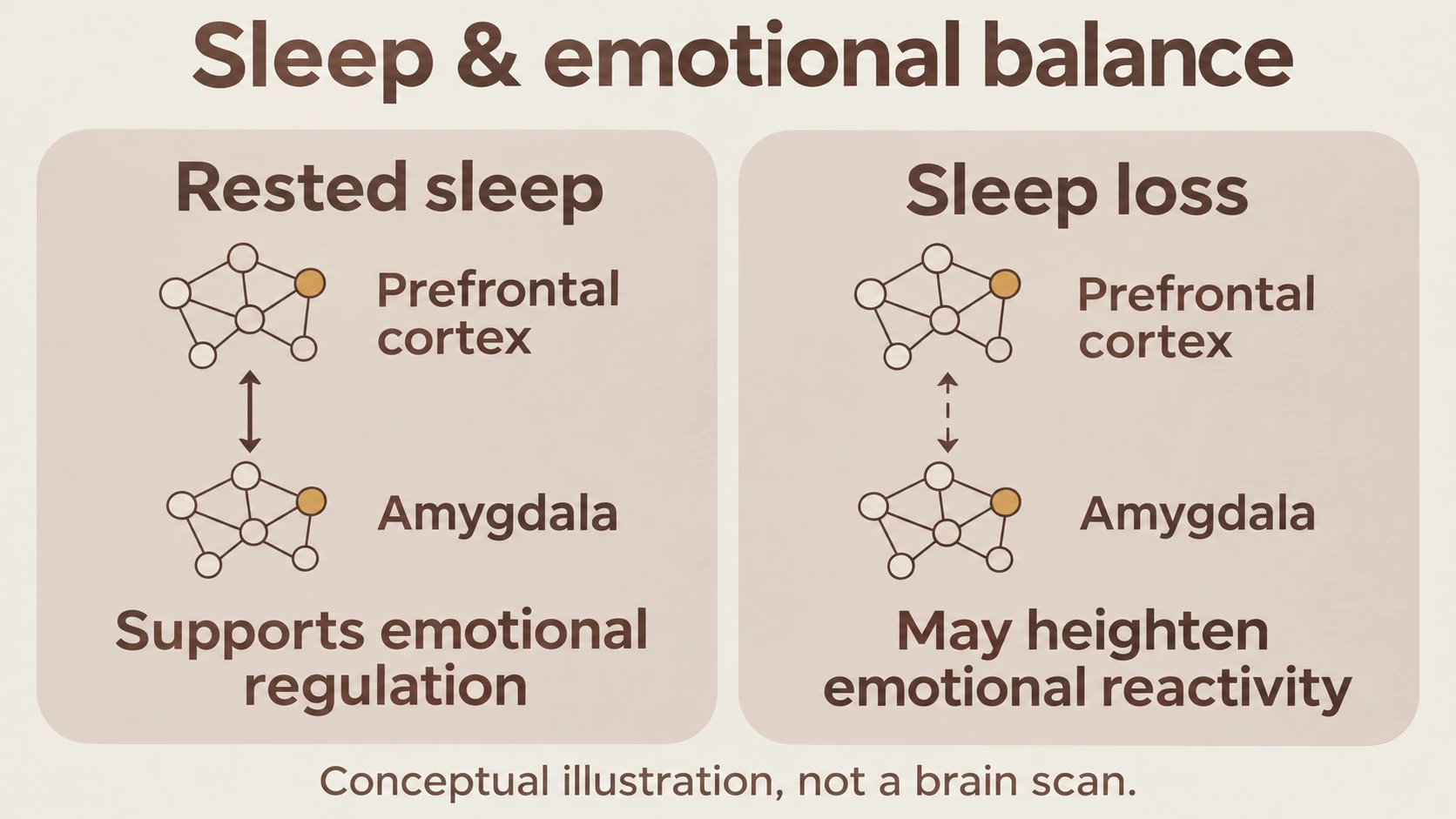
When people are short on sleep, they are more prone to irritability and anxiety and more sensitive to negative events. When going to bed earlier allows someone to get more sleep, the emotional regulation network can better maintain its normal function, and everyday negative experiences may be less likely to affect their mood.
Dopamine and Sleep: How Does Sleep Affect the Way You Experience Pleasure?
Happiness depends not only on whether you feel sad, but also on whether you can find satisfaction and pleasure in everyday life.
This is closely linked to the brain's reward system.
Several important regions are involved:
- The ventral tegmental area (VTA): contains dopamine neurons that project to other brain regions.
- The nucleus accumbens and other parts of the striatum: are involved in motivation, reward value, and reward learning.
- The prefrontal cortex: helps evaluate rewards, control behavior, and make choices.
Dopamine's main roles here involve motivation, reward prediction, and learning. It shouldn't be understood simply as a "happiness hormone."
Why Does Sleep Affect This System?
When you stay awake too long, signals associated with sleep pressure, such as adenosine, gradually build up.[3] Sleep loss also changes dopamine receptor availability and functional activity across different parts of the reward network.[6][7] This affects how the brain judges whether a stimulus is worth pursuing, how great the reward is, and whether to take action.
Interestingly, sleep loss doesn't necessarily reduce activity throughout the reward system. Some experiments have found that acute sleep deprivation actually makes regions such as the ventral striatum respond more strongly to rewards while weakening prefrontal regulation.[7] In other words, sleep loss may make reward responses less stable or more imbalanced, rather than simply depriving the brain of its ability to feel pleasure.
From this perspective, getting enough sleep helps maintain more normal reward processing, allowing us to experience everyday pleasure and satisfaction more consistently.
Waking Up Early and Morning Light: How Does Morning Light Affect Mood?
Along with when you go to bed, when you encounter natural light in the morning also matters. The retina contains a type of light-sensitive ganglion cell. These cells use a light-sensing system containing melanopsin to detect ambient light and send information to the suprachiasmatic nucleus.[4]
It's like telling your body clock: daytime has begun.
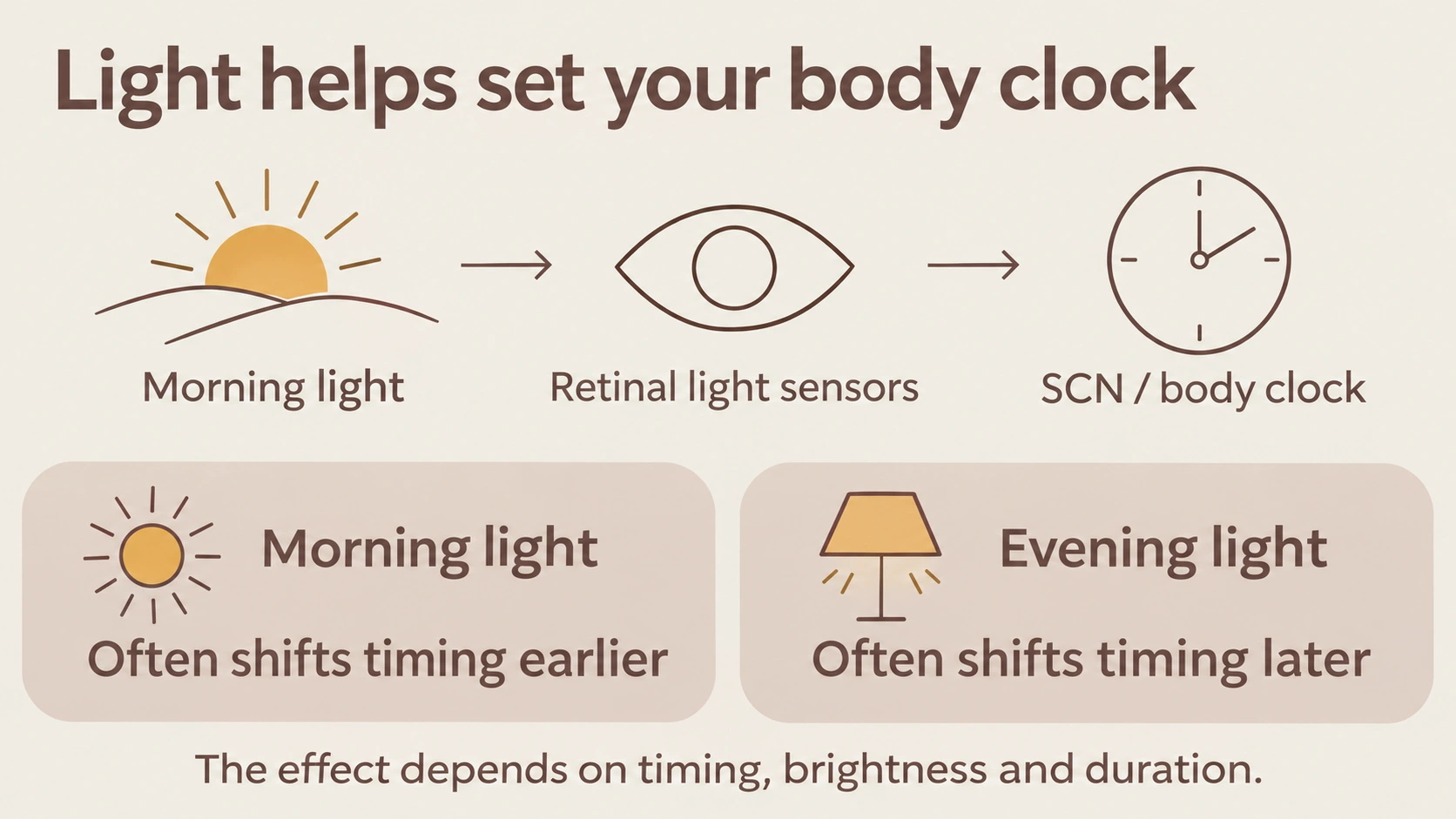
Morning light usually helps shift the body clock earlier, while light at night may shift it later.[8] Light can also affect alertness and mood through the circadian system and other neural pathways.[4][9]
So, if someone adopts an earlier, consistent wake-up time and regularly gets natural morning light, it may help stabilize their body clock and make it easier to feel sleepy at the expected time at night. A stable circadian rhythm over time may indirectly support a better mood.
How Do These Mechanisms Work Together?
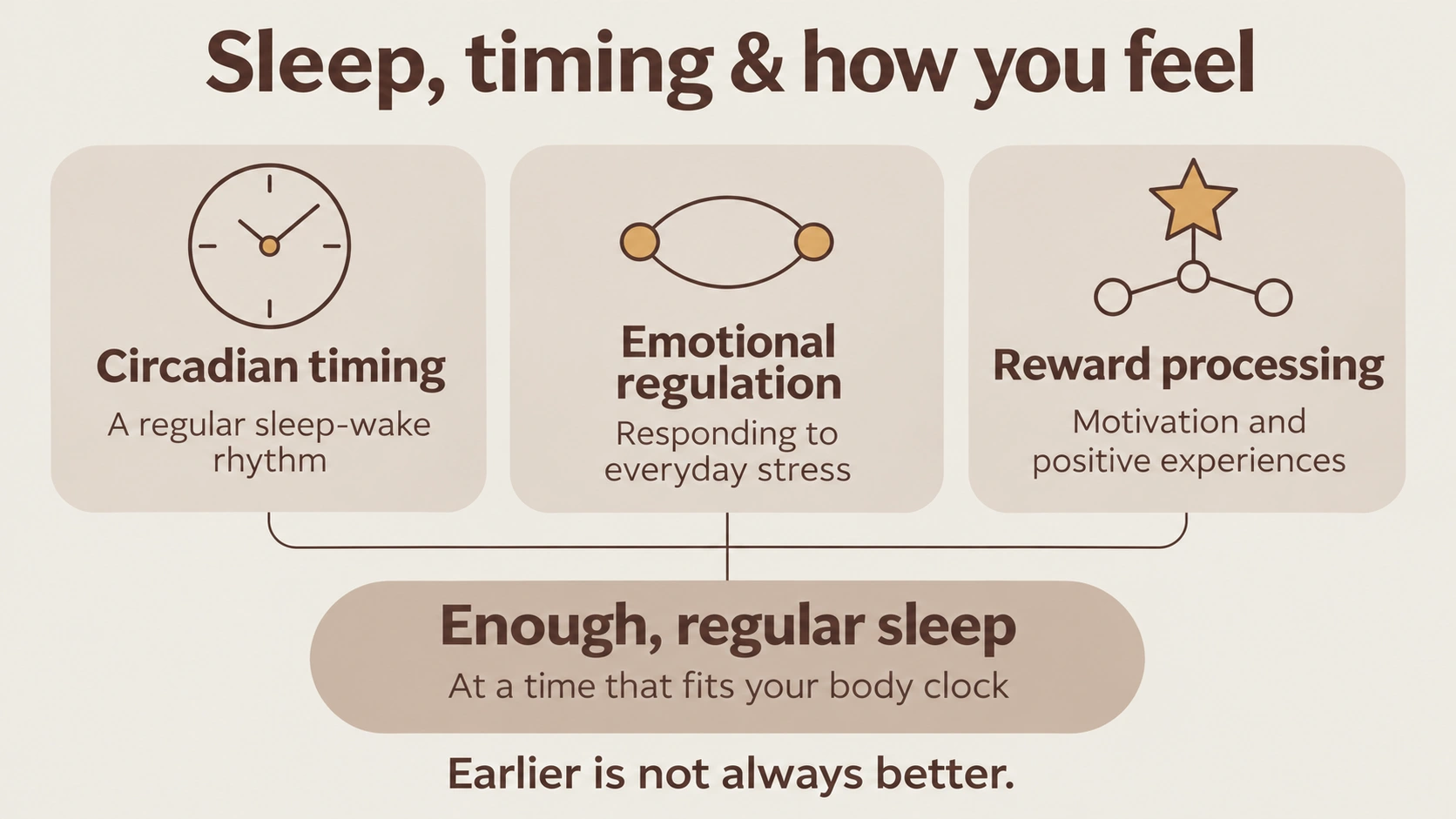
Going to bed and waking up early may improve happiness, not because a particular bedtime has special powers, but because getting enough sleep at a time that fits your body clock helps the body and brain function normally. Stable circadian rhythms coordinate sleep and wakefulness, while sufficient sleep helps maintain emotional regulation and reward-system function. Together, these help us cope with negative emotions and enjoy positive experiences in everyday life.
What really matters, then, isn't going to bed as early as possible. It's finding a sleep schedule that works for you and getting enough regular rest.
If you'd like to put these ideas into practice tonight, start by checking whether light or noise in your bedroom is interfering with your rest. The bedroom sleep environment guide offers a closer look. If the harder part is quieting a busy mind before bed, you can also explore NSDR bedtime relaxation exercises and give yourself some time to transition from a busy day to rest.
If you like listening to soothing sounds as you get ready for sleep, DUVA ONE is one option for a personal audio tool. Features described on the official website include calming soundscapes, breathing guidance, and noise masking. Its low-profile design also takes into account contact with a pillow during side sleeping. Whether you use it depends on your habits and how comfortable it feels to wear; it cannot replace sufficient, regular sleep.
Frequently Asked Questions About Early Bedtimes and Happiness
Can Going to Bed Early Really Make You Happier?
Going to bed early may help improve your mood, but earlier doesn't always mean happier. If an earlier bedtime allows you to get more sleep and reduces conflict between your sleep schedule and body clock, it may help your brain regulate emotions more effectively and make it easier to experience pleasure and satisfaction in everyday life.
What Bedtime Is Best for Happiness?
There is currently no evidence that one fixed bedtime is best for happiness. For most adults, what matters more is getting about 7–9 hours of sleep each night and keeping a relatively regular schedule.[10] You can plan your bedtime around when you need to wake up the next day and when you naturally feel sleepy.
Are Night Owls Less Happy Than Early Birds?
Not necessarily. Some studies have found that morning types generally report more positive emotions[11], but that doesn't mean evening types are inherently less happy. Happiness is also influenced by sleep quality, sleep duration, and how well a person's schedule fits their body clock. If you tend to stay up late but get enough regular sleep and feel good during the day, you don't necessarily need to force yourself to go to bed early.
Why Does Sleep Loss Make People More Irritable?
Sleep loss may make the amygdala more sensitive to negative stimuli while affecting the prefrontal cortex's ability to regulate emotions.[5] That means small things you could normally handle easily may trigger more irritability, anxiety, or frustration when you're short on sleep. Getting enough sleep helps these brain regions work together normally.
If I Get 8 Hours of Sleep, Does It Matter When I Sleep?
Yes, it can. Sleep duration matters, but whether your sleep schedule aligns with your circadian rhythm also affects your sleep experience.[3] If your sleep schedule repeatedly conflicts with your body clock or daily demands, you may have poorer sleep quality or daytime sleepiness even after spending 8 hours in bed. That doesn't mean everyone needs to be asleep before 10 p.m.
References
- [1] Palmer CA, et al. Sleep loss and emotion: A systematic review and meta-analysis of over 50 years of experimental research. Psychological Bulletin. 2024;150(4):440–463. DOI: 10.1037/bul0000410.
- [2] National Institute of General Medical Sciences. Circadian Rhythms. Updated 2025.
- [3] National Heart, Lung, and Blood Institute. How Sleep Works: Your Sleep/Wake Cycle. 2022.
- [4] Vadnie CA, McClung CA. Circadian Rhythm Disturbances in Mood Disorders: Insights into the Role of the Suprachiasmatic Nucleus. Neural Plasticity. 2017;2017:1504507. DOI: 10.1155/2017/1504507.
- [5] Goldstein AN, Walker MP. The Role of Sleep in Emotional Brain Function. Annual Review of Clinical Psychology. 2014;10:679–708. DOI: 10.1146/annurev-clinpsy-032813-153716.
- [6] Volkow ND, et al. Evidence that sleep deprivation downregulates dopamine D2R in ventral striatum in the human brain. Journal of Neuroscience. 2012;32(19):6711–6717. DOI: 10.1523/JNEUROSCI.0045-12.2012.
- [7] Gujar N, Yoo SS, Hu P, Walker MP. Sleep deprivation amplifies reactivity of brain reward networks, biasing the appraisal of positive emotional experiences. Journal of Neuroscience. 2011;31(12):4466–4474. DOI: 10.1523/JNEUROSCI.3220-10.2011.
- [8] Centers for Disease Control and Prevention, NIOSH. Effects of Light on Circadian Rhythms. Reviewed 2020.
- [9] Centers for Disease Control and Prevention, NIOSH. The Color of the Light Affects Circadian Rhythms. Reviewed 2020.
- [10] NHS. Insomnia. Reviewed 2024.
- [11] Biss RK, Hasher L. Happy as a lark: morning-type younger and older adults are higher in positive affect. Emotion. 2012;12(3):437–441. DOI: 10.1037/a0027071.