Which Side Should You Sleep On? Left vs. Right Side Sleeping
For most healthy adults, sleeping on your left side, right side, or back is not inherently better or worse. However, for people who are pregnant or have acid reflux, sleep apnea, heart conditions, or back pain, choosing the right sleeping position may help ease related symptoms. This article explains how different sleeping positions affect your body, drawing on anatomy and physiology to help you find a position that works for you.
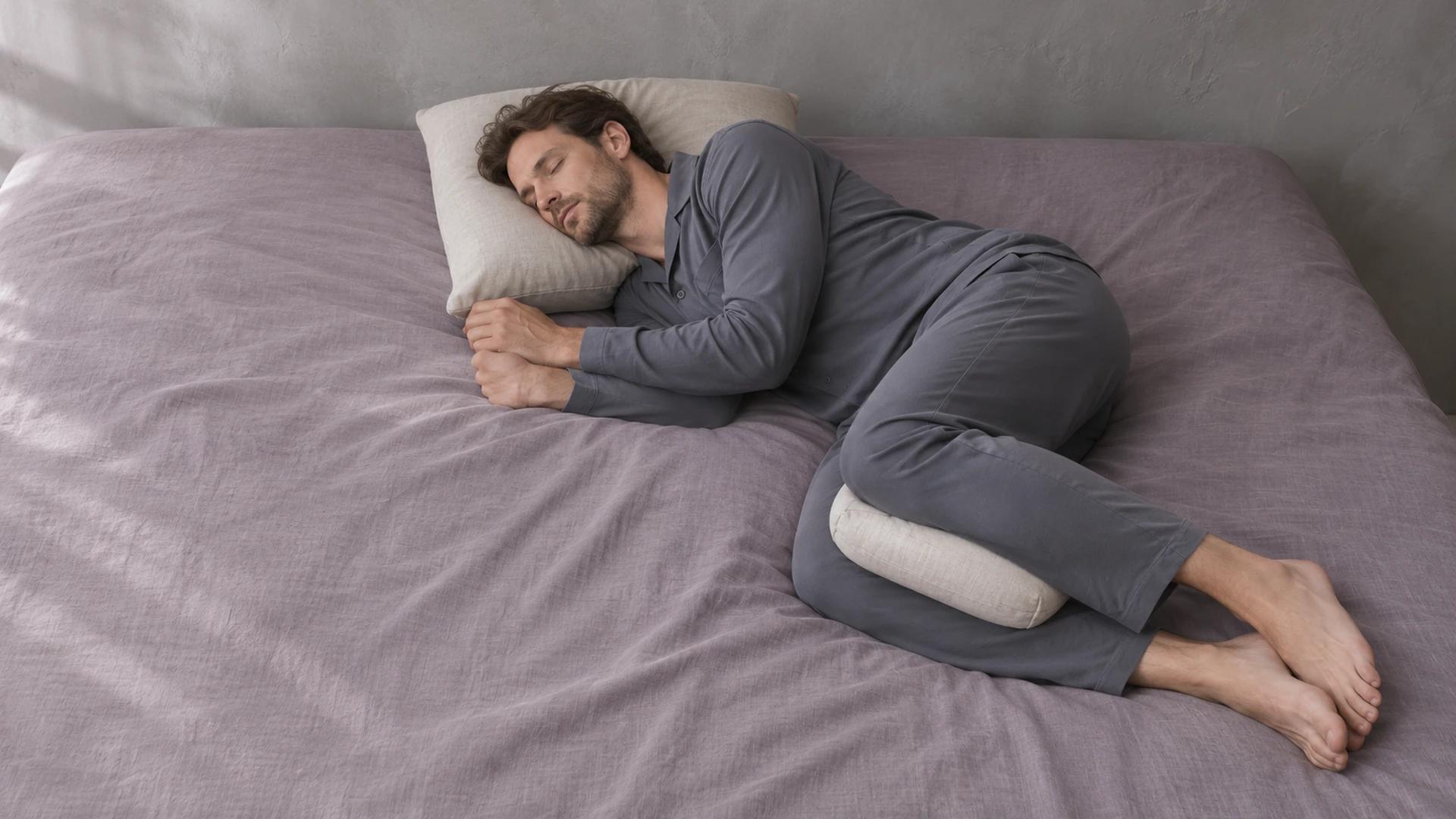
Have you heard that sleeping on your left side puts pressure on your heart, sleeping on your right side interferes with digestion, or sleeping on your back is the healthiest option? In fact, for healthy adults, the body's organs and surrounding tissues can adapt to the pressure and shifts in position that come with normal sleeping positions, so there is no need to deliberately change the way you usually sleep.
However, during certain physiological states or with particular health conditions, the effects of sleeping position may become more important. Different positions change how gravity acts on your internal organs, blood vessels, and airways, while also affecting spinal alignment and how pressure is distributed across your body. That is why some people may do better on their left side, while others may prefer their right side or back.
So which sleeping position should different people choose, and what are the physiological reasons behind those recommendations?
Best Sleeping Position During Pregnancy
As pregnancy progresses, the uterus grows. When a pregnant person lies on their back, gravity may cause the enlarged uterus to compress the inferior vena cava, a major vein that runs in front of the spine.
The inferior vena cava carries blood from the lower body back to the heart. When this vein is compressed, less blood may return to the heart, which can affect cardiac output and blood flow to the uterus and placenta. Because the inferior vena cava runs mainly along the right side of the spine, sleeping on the left side is anatomically helpful in relieving this pressure. This is why left-side sleeping has traditionally been recommended during pregnancy.
However, current research suggests that after 28 weeks of pregnancy, both left- and right-side sleeping are reasonable choices in terms of pregnancy outcomes. There is not enough evidence to suggest that sleeping on the right side is more dangerous than sleeping on the left. [1]
In late pregnancy, the more important goal is to fall asleep on your side rather than force yourself to stay on your left side all night. Placing a pillow between your knees or under your abdomen can also provide extra support and ease pressure on your lower back and hips. [2]
Best Sleeping Position for Acid Reflux
For people who frequently experience acid reflux, heartburn, or acid regurgitation at night, sleeping on the left side is generally more helpful than sleeping on the right side or back. This largely comes down to the stomach's anatomy and the effects of gravity.
The stomach sits mainly in the upper-left part of the abdomen, and the esophagus connects to it at the gastroesophageal junction. When you lie on your left side, fluid in the stomach tends to collect farther away from this junction, making it less likely for stomach acid to flow up into the esophagus. When you lie on your right side, the junction sits lower relative to the fluid in your stomach, making reflux more likely. [5]
A 2022 study monitored sleeping position and esophageal pH simultaneously in 57 patients. It found clear differences in the median time it took the esophagus to clear stomach acid in different sleeping positions. [3]
Esophageal Acid Clearance Time by Sleeping Position
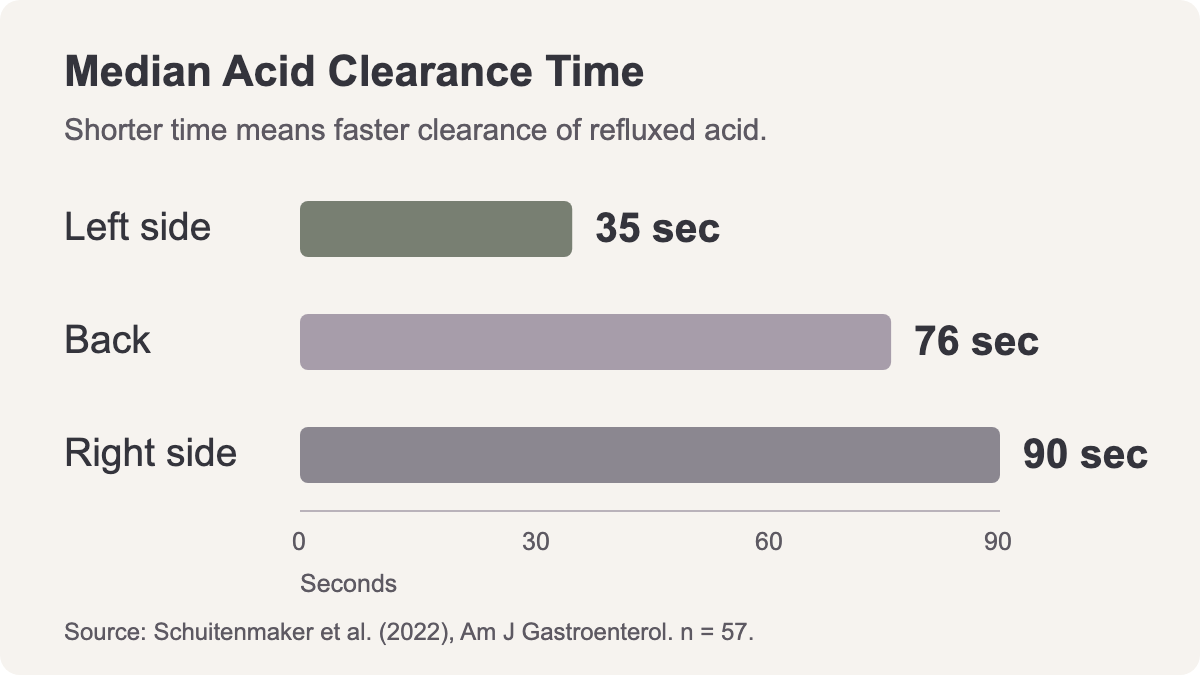
Source: Schuitenmaker et al. (2022). [3]
A 2023 systematic review and meta-analysis also found that sleeping on the left side helped reduce nighttime acid exposure and improve GERD-related symptoms. [4]
So if you frequently experience acid reflux at night, try sleeping on your left side, raising the head of your bed, and avoiding food for 2–3 hours before bedtime. [5]
Best Sleeping Position for Sleep Apnea
Obstructive sleep apnea occurs mainly because the upper airway repeatedly narrows or collapses during sleep, reducing airflow or briefly interrupting breathing altogether.
As you fall asleep, the muscles that keep your upper airway open gradually lose tone. When you lie on your back, gravity makes the base of your tongue, soft palate, and surrounding soft tissues more likely to shift toward the back of your throat, further obstructing an already narrow airway.
Sleeping on your side changes the direction in which gravity acts on these soft tissues, making them less likely to collapse backward into the airway. This can reduce snoring and episodes of sleep apnea in some people. [6]
A 2019 Cochrane systematic review found that positional therapy reduced apnea and hypopnea events by an average of 7.38 per hour compared with no positional intervention. People with positional sleep apnea can try sleeping on either side; the key is to spend less time on their back. [6]
Best Sleeping Position for People With Heart Conditions
Many people worry that sleeping on their left side puts pressure on their heart. But in people with normal heart function, the rib cage and surrounding tissues protect the heart, and a normal left-side sleeping position does not damage it.
For some people with heart failure, however, sleeping position may affect nighttime comfort. When you lie on your left side, gravity shifts the heart somewhat closer to the left chest wall. In people with an enlarged heart, this may make the heartbeat more noticeable and may be accompanied by chest discomfort or difficulty breathing. [7]
A 2003 study published in the Journal of the American College of Cardiology found that people with heart failure were more likely to avoid lying on their left side, and that this tendency was associated with heart size and function. [7]
So if sleeping on the left side causes noticeable discomfort, some people with heart failure may find it helpful to try sleeping on their right side.
Best Sleeping Position for Preventing Wrinkles
Along with aging, UV exposure, and facial expressions, repeated mechanical pressure during sleep may contribute to facial wrinkles.
When you sleep on your side or stomach, your facial skin stays in contact with the pillow. Under the weight of your head, the skin is exposed to compression, stretching, and shear forces, creating temporary creases.
As you age, collagen and elastic fibers in the skin gradually decline, reducing its ability to return to its original shape. Repeated mechanical deformation in the same areas over time may contribute to sleep wrinkles. [8]
Sleeping on your back, by contrast, reduces direct contact between your face and the pillow, physically reducing compression and shear forces on the skin. If you want to reduce pressure on your face during sleep, you can try sleeping on your back, but there is no need to sacrifice sleep quality to prevent wrinkles. [8]
Best Sleeping Position for Back Pain
For people with back pain, the key is not whether you sleep on your left or right side. It is whether your position supports the spine's natural curves and reduces the mechanical load on your lower back, pelvis, and surrounding muscles.
- When you sleep on your back with your legs fully extended, some people may experience an increased inward curve in the lower back or tension in the lower-back muscles. Placing a pillow under your knees allows your hips and knees to bend slightly, helping the lower-back muscles relax and keeping your lower spine in a more comfortable position. [9]
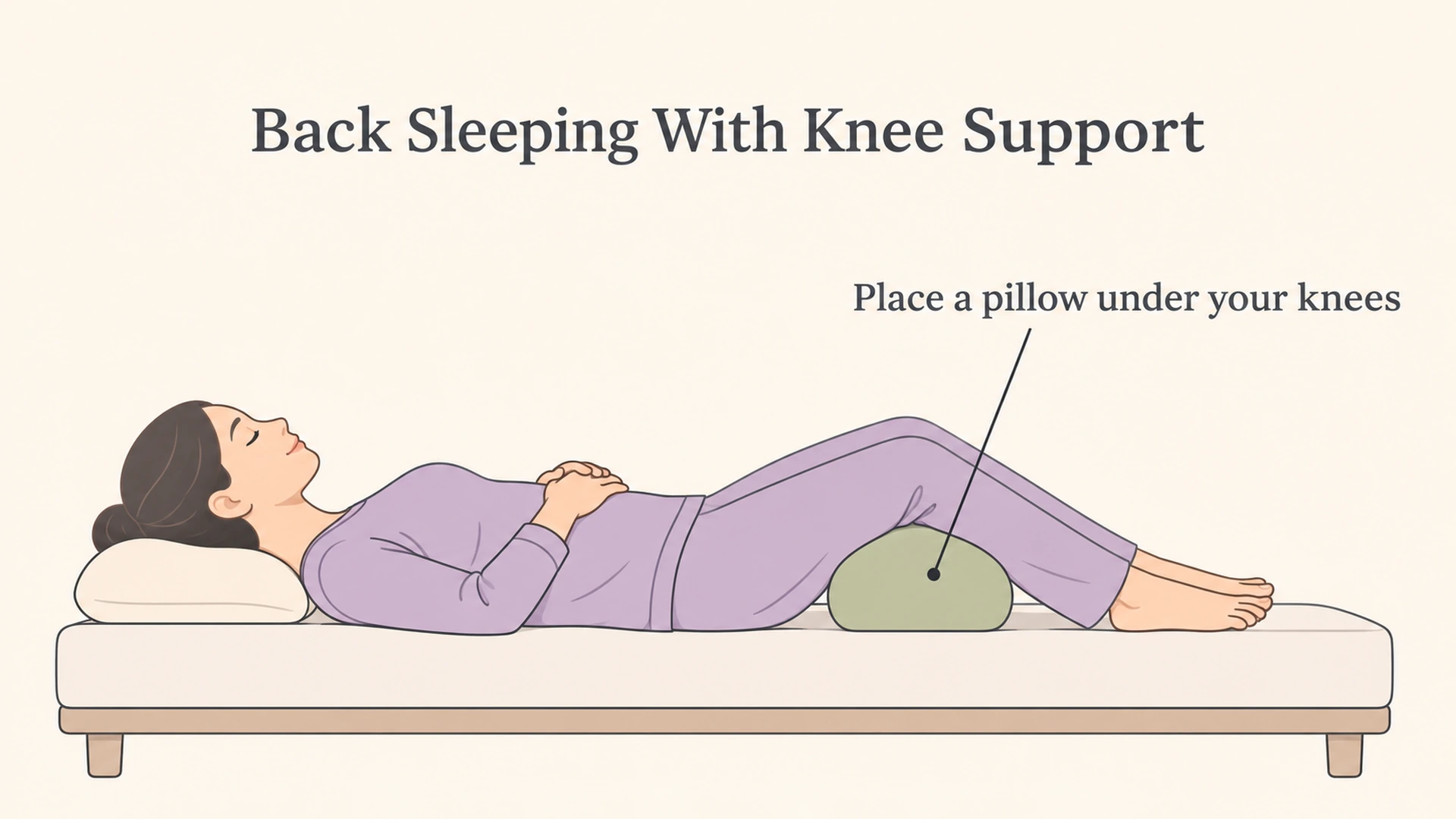
When sleeping on your back, place a pillow under your knees. [9]
- When sleeping on your side, place a pillow between your knees. Without support, your upper leg may move forward or downward under gravity, rotating the pelvis and adding twisting stress to the lower spine. A pillow between your knees can help keep your hips, pelvis, and spine naturally aligned, reducing strain on your lower back. [9]
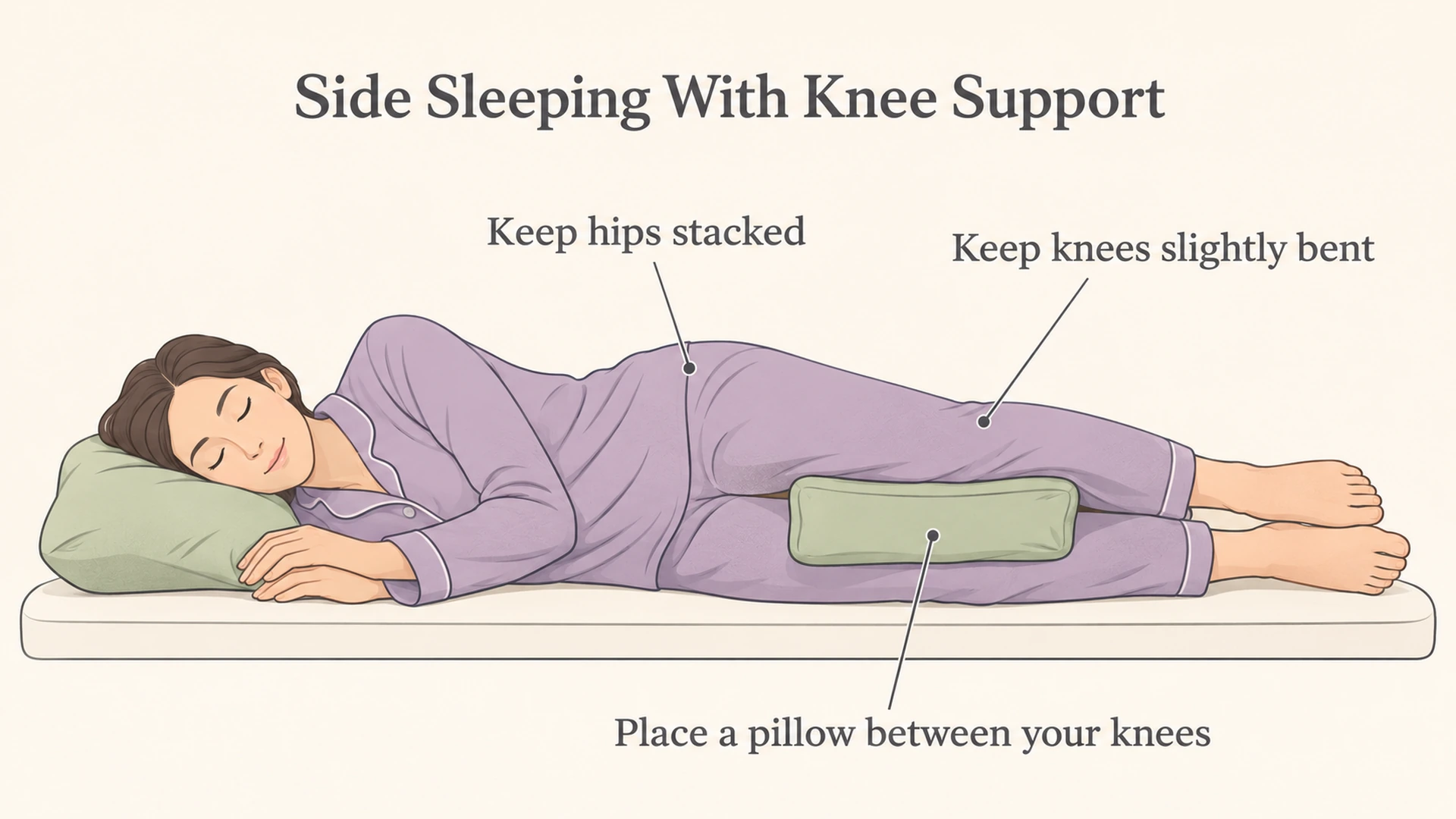
When sleeping on your side, place a pillow between your knees. [9]
Final Thoughts
For most healthy adults, sleeping on the left side, right side, or back can all be healthy choices. There is no need to force yourself to change a long-standing sleeping habit just because another position is considered healthier.
For people with specific health conditions, though, adjusting their sleeping position can be a simple and effective way to help improve symptoms.
Ultimately, the goal is not to keep your body in one fixed position all night. It is to reduce discomfort, keep your airway open, and get enough comfortable, uninterrupted sleep.
Frequently Asked Questions
Is It Better to Sleep on Your Left or Right Side?
For most healthy adults, neither side has a clear health advantage. Neither position puts harmful pressure on the heart or other internal organs. For people with certain health conditions, however, choosing the right side may offer additional benefits.
- People with GERD: Favor the left side to help reduce acid reflux and esophageal acid exposure. [3][4]
- People in late pregnancy: Either side is fine. Side sleeping helps reduce pressure from the enlarged uterus on major blood vessels. [1][2]
- People who snore or have positional sleep apnea: Either side can help reduce upper airway obstruction. [6]
- Some people with heart failure: Sleeping on the right side may be more comfortable, but the choice should depend on symptoms and medical advice. [7]
- People with back, shoulder, or hip pain: Favor the side that eases pain and local pressure, and use pillows to maintain the natural alignment of your spine and pelvis.
Is Sleeping on Your Left Side Bad for Your Heart?
No. For people with normal heart function, sleeping on the left side does not damage the heart, and there is not enough evidence to suggest that long-term left-side sleeping increases the risk of heart disease.
Is It Bad to Sleep on the Same Side Every Night?
Usually not. But if you have persistent shoulder, hip, or ear pain on one side, try switching sides or adjusting the support from your pillow and mattress to reduce local pressure.
Is Sleeping on Your Back Healthier Than Side Sleeping?
Not necessarily. Sleeping on your back helps reduce direct pressure on one side of your body and face, but side sleeping is more helpful for people with acid reflux or snoring, and for some people with sleep apnea.
Which Sleeping Position Is Best for Deep Sleep?
There is currently not enough evidence to show that any one sleeping position directly increases deep sleep. Physical comfort, an open airway, and how often you wake up at night matter more than the position itself.
References
- Cronin RS, Li M, Thompson JMD, Gordon A, Raynes-Greenow CH, Heazell AEP, Stacey T, Culling VM, Bowring V, Anderson NH, O'Brien LM, Mitchell EA, Askie LM, McCowan LME. (2019). An Individual Participant Data Meta-analysis of Maternal Going-to-Sleep Position, Interactions with Fetal Vulnerability, and the Risk of Late Stillbirth. EClinicalMedicine. PubMed · DOI
- NHS . Tiredness and sleep problems in pregnancy Source
- Schuitenmaker JM, van Dijk M, Oude Nijhuis RAB, Smout AJPM, Bredenoord AJ. (2022). Associations Between Sleep Position and Nocturnal Gastroesophageal Reflux: A Study Using Concurrent Monitoring of Sleep Position and Esophageal pH and Impedance. The American journal of gastroenterology. PubMed · DOI
- Simadibrata DM, Lesmana E, Amangku BR, Wardoyo MP, Simadibrata M. (2023). Left lateral decubitus sleeping position is associated with improved gastroesophageal reflux disease symptoms: A systematic review and meta-analysis. World journal of clinical cases. PubMed · DOI
- Schuitenmaker JM, Kuipers T, Smout AJPM, Fockens P, Bredenoord AJ. (2022). Systematic review: Clinical effectiveness of interventions for the treatment of nocturnal gastroesophageal reflux. Neurogastroenterology and motility. PubMed · DOI
- Srijithesh PR, Aghoram R, Goel A, Dhanya J. (2019). Positional therapy for obstructive sleep apnoea. The Cochrane database of systematic reviews. PubMed · DOI
- Leung RS, Bowman ME, Parker JD, Newton GE, Bradley TD. (2003). Avoidance of the left lateral decubitus position during sleep in patients with heart failure: relationship to cardiac size and function. Journal of the American College of Cardiology. PubMed · DOI
- Anson G, Kane MA, Lambros V. (2016). Sleep Wrinkles: Facial Aging and Facial Distortion During Sleep. Aesthetic surgery journal. PubMed · DOI
- MedlinePlus Medical Encyclopedia . Taking care of your back at home Source